Meat Cutter Machine review fits buyers who need a compact electric slicer for fresh meat and soft vegetables, not a general-purpose food processor.
If you are asking whether this Meat 850W commercial meat cutter is worth it, the answer depends on how closely your prep list matches its intended use.
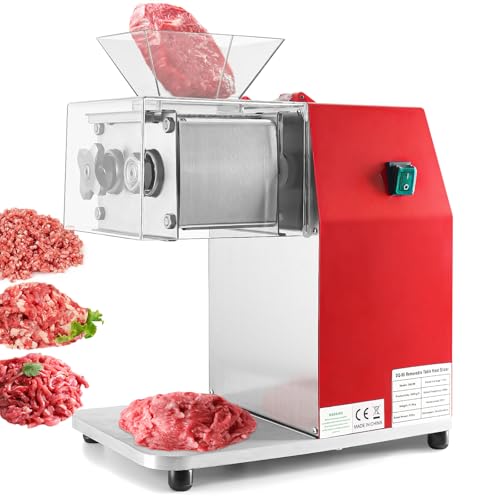
Meat Cutter Machine Review Summary
This Meat 850W commercial meat cutter is best for restaurants, supermarkets, and serious home cooks who regularly process fresh meat in repeatable batches.
Its strongest appeal is straightforward: high power, a stainless-steel build, and a feed chute sized for efficient loading, all aimed at faster prep with less manual cutting.
The tradeoff is equally clear.
The listing positions it as a specialist machine for fresh meat and soft vegetables, and it explicitly warns against bone-in meat, frozen meat, and hard vegetables.
That makes it a focused tool rather than a universal kitchen appliance.
**Buy it if your workflow is built around sliced meat, shredded meat, or strip cuts.
Skip it if you need something that can handle everything.**
Review Scorecard
| Category | Score | Buyer-focused rationale |
|---|---|---|
| Cutting throughput | 9/10 | The listing claims 551 lbs/h capacity and 850W power, which points to serious batch processing ability. |
| Material quality | 8/10 | Stainless steel plus aluminum alloy suggests a durable, cleanable commercial-style build. |
| Versatility | 7/10 | It slices, strips, and shreds, but within a narrow ingredient range. |
| Ease of use | 8/10 | A 6.1 x 4.5 inch feed chute and multi-pass design should simplify routine prep. |
| Maintenance | 7/10 | Stainless surfaces help, but the blade assembly still needs careful cleaning and post-wash oiling. |
| Buyer fit | 9/10 | Strong fit for food-service prep and large-volume home cooking centered on fresh meat. |
| Everyday flexibility | 5/10 | The use restrictions sharply limit what you can safely feed it. |
Key Features and Specifications of Meat Cutter Machine
The core specification is the 850W motor, paired with a claimed processing capacity of 551 pounds per hour.
That combination makes the machine look much more like a batch prep tool than a small countertop gadget.
For operators who need consistent output over repeated runs, that is the central selling point.
The machine is designed to slice, strip, and shred ingredients through multiple passes.
The feed chute measures 6.1 x 4.5 inches, which should help reduce loading friction and support a more efficient workflow when handling prepared pieces.
The body uses stainless steel, aluminum alloy, and PVC, with the stainless steel specifically called out as food-safe and easy to maintain.
The overall dimensions are 14.17 x 8.66 x 18.11 inches.
That is compact enough for a countertop footprint, but the machine still reads as a sturdy, purpose-built appliance rather than something you would tuck away casually after each use.
| Specification | What the listing says | Why it matters |
|---|---|---|
| Power | 850W | Signals enough motor strength for heavy-duty prep. |
| Capacity | 551 lbs/h | Suggests high-volume throughput for busy service periods. |
| Functions | Slice, strip, shred | Covers the most common meat-prep outcomes in one unit. |
| Feed chute | 6.1 x 4.5 inches | Supports easier loading and faster batching. |
| Materials | Stainless steel, aluminum alloy, PVC | Points to durability and easier cleaning. |
| Intended use | Fresh meat and soft vegetables | Clarifies the machine’s real operating range. |
| Not for | Bone-in meat, frozen meat, hard vegetables | Defines the key buying limitation. |
The usage notes matter as much as the specs.
The machine is designed for pork, beef, lamb, mushrooms, bell peppers, and leafy greens, but it should not be treated like a universal cutter.
That is not a defect; it is a design boundary.
Buyers who understand that boundary will likely get a much better result than buyers who expect one machine to do every prep task.
Pros and Cons of Meat Cutter Machine
Pros
- Strong 850W motor for demanding prep workflows.
- Claimed 551 lbs/h output supports high-volume use.
- Slices, strips, and shreds instead of doing just one job.
- Stainless-steel construction should be easier to clean than mixed-material designs.
- Compact enough to fit on a countertop without looking oversized.
- Clear ingredient guidance helps set realistic expectations.
Cons
- Not suitable for bone-in meat.
- Not suitable for frozen meat.
- Not suitable for hard vegetables like potatoes or hard carrots.
- Multiple-pass operation may take some practice to use efficiently.
- Best value depends on whether you actually need a specialized meat cutter.
The biggest pro is throughput.
The biggest con is scope.
Those two points are tied together: the machine appears optimized for speed and consistency inside a narrow lane.
If that lane matches your prep needs, it is a strength.
If not, the specialization turns into a limitation quickly.
Who Should Buy Meat Cutter Machine?
This Meat 850W commercial meat cutter makes the most sense for buyers who prep fresh meat regularly and want cleaner, faster output than manual knife work provides.
That includes restaurant kitchens, hot-pot prep stations, deli-style operations, small supermarkets, and home users who cook large batches for family gatherings.
It should also appeal to buyers who care about repeatable slices, strips, or shredded meat rather than highly varied culinary tasks.
The listing’s emphasis on durable materials and easy maintenance suggests a machine intended for routine use, not occasional novelty.
You should probably skip it if you mostly cook frozen ingredients, bone-in cuts, or hard vegetables.
You should also skip it if you need one appliance that can handle everything from raw produce to tough proteins to mixed prep jobs.
This is a specialist cutter, not a universal kitchen machine.
Fresh Meat Prep Limits and Workflow
Why the ingredient limits matter
The machine is explicitly designed for fresh meat and soft vegetables.
That means the core question is not whether it can cut food, but whether your normal ingredients fall inside its safe operating envelope.
Buyers who ignore the limits risk disappointment and avoidable wear.
What the multi-pass design implies
Because the machine slices, strips, and shreds through multiple passes, the user experience is likely to be more structured than simple one-pass slicing.
That can be a positive if you want control and repeatability, but it also means the machine rewards a little process discipline.
What the construction suggests
Stainless steel and aluminum alloy usually matter most in real kitchens because they support easier wiping, better corrosion resistance, and a more professional feel.
The machine’s compact footprint strengthens the impression that it is meant to live on a work surface and stay in rotation.
Maintenance and long-term use
The recommendation to apply a small amount of cooking oil to the blade assembly after cleaning is a useful clue about ownership.
This is not a set-and-forget appliance.
It is a piece of equipment that rewards basic upkeep, especially if you want to keep the blade assembly operating smoothly over time.
Alternatives to Meat Cutter Machine
If you need a different balance of capability and flexibility, consider these Amazon-searchable alternatives:
Weston and LEM are worth a look if you want equipment lines that often show up in serious prep contexts.
VEVOR is a practical comparison point for buyers shopping for industrial-leaning value.
Chef’sChoice is more relevant if your use case is closer to slicing than to heavy meat processing.
Is Meat Cutter Machine Worth It?
Yes, but only for the right buyer.
The Meat 850W commercial meat cutter is worth considering if your workflow centers on fresh meat, efficient batch prep, and simple maintenance, and if you are comfortable with the ingredient restrictions.
It is not the best choice for buyers who want broad versatility, frozen-food handling, or the ability to cut hard vegetables and bone-in products.
**For a focused kitchen that needs fast, repeatable meat prep, it looks like a sensible buy.
For everyone else, the limitations are too important to ignore.**