The best electric dough kneading machines take much of the effort out of preparing bread, pizza, and sourdough. These models vary widely in bowl capacity, control systems, fermentation features, and intended workload.
Our roundup compares 10 options, from compact home dough makers to heavy-duty commercial mixers, so you can match performance and capacity to your baking routine.
Best 10 Electric Dough Kneading Machines Picks for 2026
Best Heavy-Duty Capacity

- 30-quart stainless steel container
- 1500W motor with dual gears and belts
- Forward/reverse rotation and tilting bowl
Best For: Commercial kitchens handling large dough batches
Best Dual-Rotation Mixer
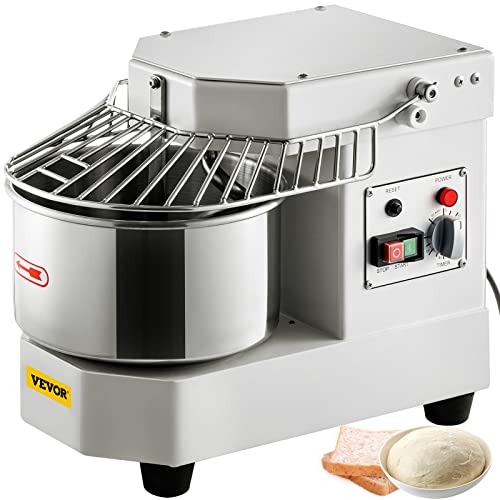
- Dual bowl-and-hook rotation
- 8-liter, 3-kg dough capacity
- 60-minute timer and safety shield
Best For: Small commercial kitchens needing consistent timed mixing
Best Versatile Fermentation Control

- Four mixing and fermentation modes
- Winter and Summer fermentation settings
- 9.5-quart capacity with adjustable timing
Best For: Home bakers making varied doughs and fillings
Large-Batch Pick

- 6.5L bowl handles up to 1600g of flour
- Mixes and ferments in one machine
- Ingredient chute supports additions while running
Best For: Families and larger home-baking batches
Compact Quiet Choice

- Supports 198–1077g of dry flour
- Timed mixing and fermentation programs
- Suction feet help limit shaking
Best For: Smaller households and moderate dough batches
Smart Proofing Pick
AIZIYO DoughChief 7.4-Quart Mixer
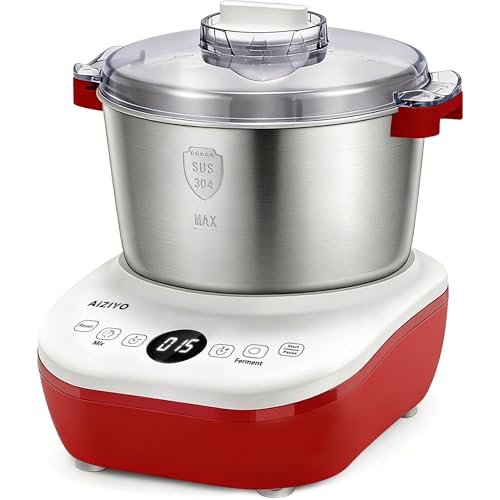
- Large 7.4-quart stainless steel bowl
- Mix–pause–mix S-blade kneading program
- Touch controls with 77–100°F fermentation
Best For: Home bakers wanting large capacity and guided proofing
Quiet Kneading Choice

- 300–1,400g dough capacity
- Mix-pause-mix kneading pattern
- Low-noise, stable operation
Best For: Quieter everyday dough preparation
Best Compact Fermentation Maker – Joydeem 7.4Qt Dough Maker
For home bakers comparing electric dough kneading machines, the Joydeem JD-HMJ7L combines timed mixing with a fermentation function in a space-saving vertical design. Its 250W motor can knead dough in about 15 minutes and complete kneading plus proofing in about 45 minutes.
Best For: Home bakers who want automatic kneading and proofing for bread, pizza, buns, or dumplings.
Pros:
- Microcomputer controls support preset timing and automatic programs.
- 6.6-quart capacity suits larger household batches.
- Stainless steel bowl and blade are dishwasher safe, and the removable cover aids cleaning.
- Suction cups and a weighted body help reduce movement and noise.
Cons:
- It has one speed and no speed adjustment.
- The listed noise level is 70 dB.
- The base is not dishwasher safe.
This is a practical choice when convenience and proofing matter more than heavy-duty commercial capacity. The face-up controls and included measuring tools make it approachable for routine home baking.
Best Heavy-Duty Capacity – 30QT Commercial Dough Mixer
Among electric dough kneading machines, this 30-quart commercial mixer is designed for substantial batches and demanding environments. Its 1500W motor, double gears and belts, and forward-and-reverse mixing support high-volume dough preparation.
Best For: Schools, bakeries, restaurants, and other operations needing a large-capacity commercial mixer.
Pros:
- 30-quart stainless steel container accommodates large batches.
- 1500W motor and 40 rpm mixing rod provide strong kneading power.
- Forward and reverse rotation helps with dough making and removal.
- Tilting the container 90 degrees makes cleaning and unloading easier.
Cons:
- At 109.3 pounds, it is difficult to move frequently.
- Its 25.19-by-26.77-by-19.68-inch footprint requires substantial space.
- The listed noise level is 85 dB.
This mixer is best evaluated as fixed commercial equipment rather than a countertop home appliance. Its large capacity and durable construction can improve throughput, but buyers should plan for the space, weight, and noise.
Best Dual-Rotation Mixer – VEVOR 8.5Qt Commercial Mixer
The VEVOR BDM8 is a commercial-style option among electric dough kneading machines, using dual rotation to mix dough more evenly. Its 450W motor, 8-liter bowl, and adjustable timer suit bakeries, restaurants, and other food-preparation settings.
Best For: Small commercial kitchens that need dual-rotation kneading and timed operation.
Pros:
- Dual rotation combines a 21 rpm bowl with a 159 rpm hook.
- 8-liter capacity can handle up to 3 kg of dough at one time.
- Food-contact parts are made from food-grade stainless steel.
- Timer supports mixing periods up to 60 minutes.
Cons:
- It has one speed rather than multiple speed settings.
- At 81.6 pounds, it is not especially portable.
- The security shield must be closed for operation.
The BDM8 offers a useful balance between commercial construction and a smaller capacity than the 30-quart model. Its safety shield, nonslip feet, and timer make it well suited to repeatable kitchen workflows.
Best Versatile Fermentation Control – Joydeem 9.5Qt Dough Maker
For buyers seeking flexible electric dough kneading machines, the Joydeem HMJ-A901 adds separate mixing, blending, and seasonal fermentation modes. Its 300W intermittent-kneading action is intended for doughs ranging from bread and pizza to roti, dumplings, and sourdough.
Best For: Home bakers who want adjustable kneading, filling mixing, and year-round fermentation settings.
Pros:
- Four modes cover Mix, Ferment, Mix + Ferment, and Blend.
- Winter and Summer fermentation options support different conditions.
- 9.5-quart capacity handles 900 to 2800g of flour, with a 2500g maximum for fermented dough.
- Mixing and fermentation times are adjustable for more control.
Cons:
- The 300W motor is less powerful than the listed commercial models.
- It is intended for home use under the stated one-year replacement coverage.
- The vertical unit still requires a dedicated countertop area.
This model stands out for control rather than raw commercial power. Its larger household capacity and dedicated fermentation modes make it a strong fit for varied baking routines, especially when dough timing changes with the season.
Large-Batch Pick – VEVOR 6.9-Quart Dough Mixer
For shoppers comparing electric dough kneading machines for family baking, the VEVOR offers a roomy 6.5-liter stainless steel bowl, a 250W motor, and integrated fermentation. Its 150 RPM mixing action is designed to reduce hands-on kneading for breads, pizza, dumplings, and other doughs.
Best For: Families and home bakers who regularly prepare larger batches and want mixing and proofing in one appliance.
Pros:
- Handles up to 1600g of flour, suitable for larger household batches.
- Combines dough kneading with constant-temperature fermentation.
- Detachable ingredient chute allows additions without stopping the machine.
- Digital controls support convenient operating-time settings.
Cons:
- Its larger capacity and roughly 9.3-pound weight may be more than small kitchens need.
- The single 250W motor configuration does not offer listed speed adjustment.
The VEVOR stands out among electric dough kneading machines when capacity matters most. Its integrated ferment function and add-ingredient chute make it a practical choice for frequent, batch-oriented home baking.
Compact Quiet Choice – Bear 3.7-Quart Dough Maker
The Bear is a compact option among electric dough kneading machines, with a 3.7-quart stainless steel bowl and capacity for 198–1077g of dry flour. Its timed mix and fermentation programs simplify preparation for smaller portions of bread, pizza, roti, dumplings, and sourdough.
Best For: Smaller households and bakers who prioritize a compact footprint, straightforward controls, and quieter operation.
Pros:
- Compact 3.7-quart design accommodates batches from 198–1077g of flour.
- Offers adjustable mixing up to 40 minutes and fermentation up to 120 minutes.
- Constant-temperature fermentation operates from 77–100°F.
- Suction-cup feet help stabilize the machine and reduce shaking.
Cons:
- Its smaller capacity is less suited to large family-sized batches.
- Only one speed is listed, with no speed adjustment.
- The 120W motor is less powerful than some larger models in this selection.
The Bear is a sensible everyday pick if you need electric dough kneading machines for moderate quantities rather than large production. Its timed programs, stainless-steel construction, and stability-focused base keep operation simple.
Smart Proofing Pick – AIZIYO DoughChief 7.4-Quart Mixer
The AIZIYO DoughChief combines a 7.4-quart 304 stainless steel bowl with microcomputer controls and a built-in ferment mode. For shoppers seeking electric dough kneading machines that reduce manual work, its mix–pause–mix program and S-shaped blade are designed to fold and stretch dough evenly.
Best For: Home bakers who want a large-capacity mixer with touch controls, guided kneading, and constant-temperature proofing.
Pros:
- Large 7.4-quart capacity suits bread, pizza, and pasta dough preparation.
- Mix–pause–mix operation is intended to simulate hand kneading.
- Fermentation mode maintains a stated 77–100°F range.
- Wide top opening allows ingredients to be added during mixing.
Cons:
- Only one speed is listed.
- The specified noise level is 75 dB, so it may not be ideal for noise-sensitive kitchens.
- Fermentation requires yeast or fermentation powder.
The DoughChief is a strong fit for bakers who want capacity and automated proofing without switching appliances. Its touch panel and ingredient access add convenience, while the single-speed design keeps operation focused rather than highly customizable.
Large-Batch Fermentation Pick – 7.4Qt Dough Maker
For shoppers comparing electric dough kneading machines, this 7.4-quart model emphasizes capacity, controlled fermentation, and convenient ingredient additions. Its 250-watt motor, stainless steel construction, touch controls, and intermittent kneading design make it suited to regular bread, pizza, and pastry preparation.
Best For: Large families, gatherings, and bakers who want an integrated fermentation function.
Pros:
- Large 7.4-quart capacity for preparing multiple batches.
- Constant-temperature fermentation supports consistent proofing.
- Top window allows water, seasoning, or other ingredients to be added during mixing.
- Stainless steel bowl and components are designed for durability and easier cleanup.
Cons:
- Only one speed is listed.
- The 250-watt motor may be less suited to especially demanding heavy-duty use.
- Its larger capacity may take up more counter space than smaller machines.
This is a practical choice when batch size and proofing assistance matter more than speed flexibility. The digital display, timer, auto shutoff, and fermentation settings add useful convenience for routine baking.
Quiet Kneading Choice – 6.5Qt Smart Dough Maker
Among electric dough kneading machines, this 6.5-quart model stands out for its hand-kneading simulation, timed operation, and stability features. The 304 stainless steel bowl and S-shaped blade are designed for batches ranging from 300 to 1,400 grams of dough, while the removable lid makes mid-process additions easier.
Best For: Bakers who prioritize quieter operation, mechanical controls, and hands-off fermentation.
Pros:
- Recommended dough range of 300 to 1,400 grams supports varied recipes.
- Mix-pause-mix kneading pattern is designed to build gluten efficiently.
- Constant-temperature fermentation operates from 77–95°F.
- Suction-cup base, safety buckles, and low-noise design support stable operation.
Cons:
- The bowl is not recommended for dishwasher cleaning, although the dough blade can be washed that way.
- Specific electrical and dimensional details are incomplete in the supplied listing information.
- Fermentation requires yeast or baking powder.
The removable lid, knob controls, and temperature management make this a user-friendly option for bread, pizza, pasta, and dumpling dough. Its service coverage is also a consideration for buyers seeking longer-term support.
Family Baking Value – 5.3Qt Fermenting Dough Mixer
This 5.3-quart machine is a compact option among electric dough kneading machines, with a 250-watt motor and automatic fermentation after kneading. It supports 300 to 1,600 grams of flour according to the listing, with a recommended maximum of 1,300 grams for fermentation, making it suitable for family bread, pizza, dumpling, and pastry recipes.
Best For: Home bakers who want a moderate-capacity machine with automatic proofing and touch controls.
Pros:
- 5.3-quart bowl can make up to three loaves at once.
- Automatic fermentation maintains 77–100°F after kneading.
- Transparent lid and top feeding window make monitoring and additions convenient.
- Silicone base pad is designed to reduce operating noise.
Cons:
- Fermentation capacity is recommended up to 1,300 grams of flour, below the listed maximum handling range.
- The 250-watt motor may not be ideal for very heavy or continuous dough work.
- Touch controls may be less convenient when hands are covered in flour than a knob interface.
This model balances useful capacity with a relatively compact footprint and includes the key features many home bakers need. Its clear lid, feeding window, and automatic proofing make it especially approachable for routine family baking.
How We Picked the Best Electric Dough Kneading Machines
We focused on the features that matter most during real dough preparation: bowl size, motor output, kneading performance, fermentation support, control convenience, construction, and versatility. Models with stainless steel bowls and clear timing or temperature controls earned particular attention because they are easier to maintain and more practical for frequent baking.
We also considered the intended workload. A compact machine may be more suitable for occasional household use, while a commercial-capacity mixer is better suited to repeated batches, larger recipes, or small food businesses. Product descriptions and specifications should still be checked carefully before purchase, especially for voltage, maximum flour capacity, and included accessories.
Quick Comparison
| Best For | What to Look For | Typical Capacity |
|---|---|---|
| Occasional home baking | Compact footprint, simple controls, removable parts | 3.7 to 6.5 quarts |
| Frequent bread and pizza making | Fermentation function, stainless steel bowl, timer | 6.5 to 9.5 quarts |
| Large household batches | Higher capacity, stronger motor, stable housing | 8.5 to 9.5 quarts |
| Commercial or heavy-duty use | Commercial motor, 110V compatibility, durable gearing | 8.5 to 30 quarts |
Key Buying Factors for Electric Dough Kneading Machines
Capacity and Batch Size
Quart capacity describes the bowl, not always the amount of flour or dough the machine can safely handle. Check the manufacturer’s maximum dough weight and flour limit. Oversizing a machine for small batches can reduce efficiency, while an undersized model may strain during dense dough preparation.
Motor Power and Kneading Performance
Wattage offers a useful comparison, but it is not the only measure of performance. Dense bread dough requires effective torque, stable gearing, and a dough hook designed for sustained kneading. Commercial models may handle larger workloads, but they can also be heavier, louder, and less convenient for home kitchens.
Fermentation and Controls
A built-in ferment function can maintain a controlled environment for proofing dough, reducing the need for a separate warm location. Timers, preset programs, touch panels, and temperature controls improve convenience, particularly when recipes require consistent resting periods.
Construction and Cleanup
304 stainless steel bowls are durable, resistant to food odors, and generally easy to clean. Look for removable accessories, a splash guard or lid, accessible controls, and a design that leaves enough room around the bowl for cleaning and lifting.
Who Should Buy Which Electric Dough Kneading Machines?
Choose a compact 3.7- to 6.5-quart machine if you bake occasionally, have limited counter space, or usually prepare one modest batch. A 6.5- to 9.5-quart model is a better all-around choice for families and frequent bread or pizza bakers who want fermentation support and greater flexibility.
Choose a 30-quart commercial mixer only if you regularly prepare large quantities and have suitable electrical, storage, and workspace requirements. For most home users, a mid-capacity model offers a better balance of capacity, convenience, noise, and cost. Before ordering, confirm the voltage, warranty, safety features, accessory compatibility, and return policy.