Choosing the right dough mixer can help a small bakery produce more consistent bread, pizza, pasta, and sourdough while reducing repetitive hand kneading. The best option depends on batch size, dough type, available counter space, and how often fermentation features will be used.
We selected 10 machines across several capacities and power levels, including compact countertop models and larger commercial-style mixers. Use the guide below to compare the features that matter most before buying.
Best 10 Dough Kneading Machines for Small Bakeries Picks for 2026
Best Commercial Spiral Mixer
VEVOR 8.5Qt Dual-Rotation Dough Mixer
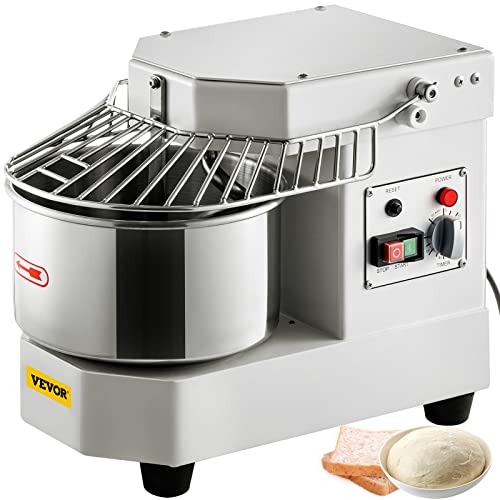
- 8-liter bowl handles up to 3 kg of dough
- Dual rotation supports even, elastic dough
- 60-minute timer and safety shield
Best For: Small bakeries needing a sturdy, high-capacity mixer
Best for Fermentation Control

- Winter and Summer fermentation modes
- 9.5-quart bowl for larger batches
- Mix, Ferment, Mix + Ferment, and Blend modes
Best For: Bakeries needing integrated dough mixing and proofing
Best High-Power Value Mixer
10L 750W Commercial Dough Mixer

- 750W copper-core motor
- 2.2–11 lb dough capacity range
- Spiral rod and chain drive rotate bowl and rod
Best For: Small bakeries prioritizing power and batch flexibility
Compact Fermentation Pick

- Kneads up to 1.4 kg of dough
- Built-in timer and fermentation heating
- Low-noise 150-watt motor
Best For: Small batches and compact bakery workspaces
Higher-Capacity Everyday Pick

- 250-watt motor at 150 RPM
- 6.5-liter stainless steel bowl
- Kneads and ferments in one machine
Best For: Larger recurring batches and varied dough recipes
Large-Batch Stability Pick

- 7.4-quart capacity for larger batches
- Intermittent kneading and fermentation
- Suction feet help reduce movement
Best For: Larger dough batches with steadier countertop operation
Best Hand-Kneading Alternative
AIZIYO DoughChief 5.3QT Dough Maker
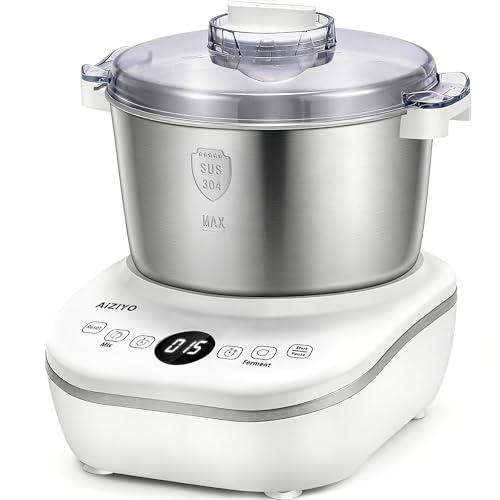
- Mix-pause-mix program supports elastic dough development
- Includes Mix, Ferment, and Mix & Ferment modes
- 304 stainless steel bowl with dishwasher-safe removable parts
Best For: Compact bakeries needing fermentation and versatile dough preparation
Best Timed Mixing Value

- 5-to-40-minute programmable mixing timer
- 140-to-170 rpm operation with a 200-watt DC motor
- Includes fermentation function and measuring accessories
Best For: Small bakeries wanting simple timed kneading in a compact machine
Best Commercial Spiral Mixer – VEVOR 8.5Qt Dual-Rotation Dough Mixer
For small bakeries needing dependable dough kneading machines for small bakeries, this VEVOR model emphasizes commercial-style capacity, dual rotation, and timed operation. Its 8-liter stainless steel bowl can handle up to 3 kg of dough, while the 450W motor is designed for efficient, relatively quiet mixing.
Best For: Small bakeries, pizzerias, restaurants, and food businesses that want a sturdy mixer for dough, fillings, cream, and other preparations.
Pros:
- Dual rotation helps combine dough evenly and improve elasticity.
- Food-grade stainless steel bowl, hook, and rod are rust- and corrosion-resistant.
- 60-minute timer, safety shield, nonslip feet, and reset button support practical operation.
- Handles up to 3 kg or 6.6 lb of dough per batch.
Cons:
- At 81.6 pounds, it is relatively heavy to reposition.
- It has one speed rather than adjustable speed settings.
- The 70 dB noise rating may matter in quieter workspaces.
This is a strong capacity-focused option when consistent kneading and commercial construction matter more than portability or multiple speeds. The dual-rotation design and timer are especially useful for repeat bakery production.
Best for Fermentation Control – Joydeem 9.5Qt Dough Maker
This Joydeem is one of the more versatile dough kneading machines for small bakeries because it combines mixing with dedicated fermentation controls. The 9.5-quart bowl supports 900 to 2,800 g of flour, while separate Mix, Ferment, Mix + Ferment, and Blend modes cover dough and filling preparation.
Best For: Small baking operations making bread, pizza, sourdough, roti, dumplings, steamed buns, and fillings across changing room conditions.
Pros:
- Winter and Summer fermentation modes provide adjustable temperature ranges and timing.
- 9.5-quart capacity accommodates substantial dough batches.
- Mix mode simulates intermittent hand kneading, while Blend mode continuously mixes fillings.
- Mixing and fermentation times can be adjusted independently.
Cons:
- The 300W motor is lower-powered than some commercial mixers.
- The recommended maximum flour and fermented-dough amounts vary by preparation.
- The design uses plastic alongside stainless steel.
Its main advantage is process flexibility rather than raw motor power. Bakeries that need built-in proofing support and multiple preparation modes may find this more useful than a basic kneader.
Best High-Power Value Mixer – 10L 750W Commercial Dough Mixer
For buyers comparing dough kneading machines for small bakeries, this 10L model focuses on motor power and straightforward commercial-style mixing. Its 750W copper-core motor, spiral rod, and chain drive are designed to work together for even kneading across batches of roughly 2.2 to 11 pounds of dough.
Best For: Small bakeries and home-commercial kitchens that prioritize strong mixing performance and a broad dough-capacity range.
Pros:
- 750W copper-core motor provides steady mixing power.
- Spiral stirring rod and simultaneous bowl rotation increase dough contact.
- 2.6-gallon bowl handles approximately 2.2 to 11 lb of dough.
- 304 stainless steel bowl and blade are durable and easy to clean.
Cons:
- The supplied specifications do not mention a timer or fermentation function.
- Mixing speeds are listed as 100/200 rpm rather than a detailed speed-control system.
- The notes do not specify safety-shield or overload-protection features.
This model is appealing when power and batch flexibility are the main considerations. It offers a simpler feature set than fermentation-focused machines, but its motor and chain-driven dual movement suit regular dough production.
Best Compact Fermenting Dough Maker – Joydeem 7.4Qt Dough Maker
This compact Joydeem offers a practical feature set for small bakeries seeking dough kneading machines for small bakeries with built-in timing and fermentation. Its microcomputer controls intermittent kneading, and the machine can complete kneading in about 15 minutes or kneading and proofing in about 45 minutes according to the supplied notes.
Best For: Small teams and compact kitchens making bread, pizza, buns, and dumplings while valuing preset programs and easy cleanup.
Pros:
- Microcomputer controls preset timing and automatic programs.
- Fermentation function and drip alert support a more hands-off workflow.
- Stainless steel bucket and blade are dishwasher safe.
- Face-up controls, suction cup, and weighted body help save space and reduce movement.
Cons:
- Its 250W motor is modest for heavier commercial workloads.
- It has one speed and no speed adjustment.
- The base is not dishwasher safe.
This is a space-conscious choice for lighter production where automation and proofing are more important than maximum throughput. The compact vertical design and removable top cover also make routine handling and cleaning more convenient.
Compact Fermentation Pick – 5.3QT Dough Kneader
For small bakeries that need dough kneading machines for small bakeries with a compact footprint, this 5.3-quart model combines hands-free kneading with timed fermentation. Its 150-watt, low-speed motor is designed for bread, pizza, pasta, and sourdough dough, with capacity for up to 1.4 kg of dough.
Best For: Small bakeries and home-based baking operations needing compact, low-noise dough preparation with built-in fermentation.
Pros:
- Removable S-shaped 304 stainless steel kneading blade
- Built-in timer and fermentation heating up to 100°F (38°C)
- 304 stainless steel, 5.3-quart bowl
- Low-speed, low-noise operation
Cons:
- Its stated capacity is limited to up to 1.4 kg of dough
- At 150 watts, it is less powerful than the larger 250-watt models in this roundup
This is a practical choice when counter space, quieter operation, and controlled proofing matter more than maximum batch size. The 5.3-quart capacity suits modest production runs, but higher-volume bakeries may prefer a larger bowl.
Higher-Capacity Everyday Pick – VEVOR 6.9-Quart Dough Mixer
This VEVOR model is one of the more flexible dough kneading machines for small bakeries, pairing a 250-watt motor with a 6.5-liter 304 stainless steel bowl. It kneads and proofs dough in one appliance and includes a digital control panel plus a detachable ingredient chute for making adjustments during operation.
Best For: Small bakeries that want larger household-scale batches and convenient kneading-to-proofing workflow.
Pros:
- 250-watt motor operating at 150 RPM
- 6.5-liter bowl handles up to 1,600 g of flour
- Combines kneading and constant-temperature fermentation
- Detachable ingredient chute and digital time settings
Cons:
- The supplied capacity specification refers to up to 1,600 g of flour, not finished dough
- At 13.19 inches tall, it may need more vertical clearance than shorter models
With a larger bowl and stronger motor than the compact option, this mixer is well suited to regular bread, pizza, dumpling, and steamed-bun preparation. The ingredient chute is especially useful when recipes need mid-process additions.
Large-Batch Stability Pick – 7.4Qt Electric Dough Maker
For bakers comparing dough kneading machines for small bakeries by bowl size and stability, this 7.4-quart electric dough maker offers a generous batch format with kneading and fermentation in one stainless steel bowl. Its intermittent kneading cycles are intended to provide rest periods, while suction feet help keep the unit steady.
Best For: Small bakeries preparing larger bread, pizza, sourdough, roll, and dumpling batches with minimal bowl transfers.
Pros:
- Largest stated capacity in this selection at 7.4 quarts
- Combines mixing, kneading, and proofing in one bowl
- Intermittent kneading can help limit heat buildup
- 304 stainless steel bowl and suction feet support cleanup and stability
Cons:
- The supplied notes do not specify a maximum dough or flour weight
- Its 250-watt motor may still be better suited to small-batch production than heavy commercial volume
This model stands out when capacity, reduced cleanup, and stability are priorities. The intermittent kneading design is useful for doughs that benefit from pauses, but bakeries should confirm the manufacturer’s recommended batch limits before scaling production.
Best Hand-Kneading Alternative – AIZIYO DoughChief 5.3QT Dough Maker
For small bakeries seeking dough kneading machines for small bakeries with fermentation support, the AIZIYO DoughChief combines a 5.3-quart stainless steel bowl with Mix, Ferment, and Mix & Ferment modes. Its programmed mix-pause-mix action is designed to imitate hand kneading for bread, pizza, pasta, mochi, and sourdough-style preparations.
Best For: Small bakeries and home-based baking operations making family-size dough batches and wanting an integrated fermentation function.
Pros:
- Mix-pause-mix program supports softer, more elastic dough development.
- Three modes provide mixing, fermentation, or combined operation.
- Food-grade 304 stainless steel bowl and dishwasher-safe removable parts simplify cleanup.
- Removable lid allows ingredients to be added during mixing.
Cons:
- The 5.3-quart capacity is smaller than the largest option in this roundup.
- Its 200-watt motor and 75 dB listed noise level may be less suited to heavier, continuous commercial workloads.
The DoughChief is a practical compact choice when fermentation control and gentler kneading matter more than maximum batch size. Its included timer and touch controls also make repeatable everyday production straightforward.
Best Timed Mixing Value – 5L Electric Dough Maker
This 5-liter electric dough maker is one of the more straightforward dough kneading machines for small bakeries, offering a customizable 5-to-40-minute timer, 200-watt DC copper motor, and 140-to-170 rpm operation. The stainless steel basin and included measuring tools suit routine dough preparation in compact kitchens or small commercial settings.
Best For: Small bakeries that prioritize adjustable kneading times, a visible lid, and a relatively compact 5-liter work bowl.
Pros:
- Built-in timer automatically stops the machine after 5 to 40 minutes.
- Fermentation function is designed to improve dough elasticity and toughness.
- Top access window makes it easier to add water while kneading.
- Includes a measuring cup, measuring spoon, dough blade, and egg separator.
Cons:
- The 5-liter capacity may require multiple batches for larger production runs.
- The 200-watt motor is positioned more toward household and light-duty use than high-volume production.
- The supplied notes do not specify dishwasher-safe removable parts.
This model makes sense for operators who want simple timed kneading and fermentation without moving to a larger countertop machine. Its clear lid and top opening add useful visibility and ingredient access during a batch.
Best Large-Batch Capacity – 7.4Qt Dough Maker with Automatic Fermentation
For small bakeries handling larger batches, this 7.4-quart dough maker offers a stated flour capacity of 300 to 2,100 grams per batch. Its 250-watt motor, automatic fermentation range of 77–100°F, detachable stainless steel bowl, and top feeding window make it a flexible option for bread, pizza, buns, dumpling wrappers, cookies, and cakes.
Best For: Small bakeries that need more capacity per batch and want automatic temperature-controlled fermentation for varied dough recipes.
Pros:
- 7.4-quart bowl accommodates up to 2,100 grams of flour in a single batch, according to the supplied specifications.
- Automatic fermentation operates at a stated 77–100°F range after kneading.
- Detachable stainless steel bowl is dishwasher safe for easier cleanup.
- Silicone noise-reduction pad and transparent lid support a quieter, visible workflow.
Cons:
- The larger bowl may take up more counter space than 5-liter or 5.3-quart alternatives.
- At 250 watts, it may still be better suited to small-batch bakery production than industrial-scale volume.
- The supplied notes do not provide a specific noise rating.
The 7.4-quart capacity gives this machine the clearest advantage for bakeries trying to reduce repeated mixing cycles. Its automatic fermentation and feeding window add convenience, while the detachable bowl keeps post-batch cleanup manageable.
How We Picked These Dough Kneading Machines for Small Bakeries
We focused on machines suited to small-bakery production rather than occasional home use alone. Key considerations included stated bowl capacity, motor power, dough-focused functions, fermentation settings, timer controls, construction materials, and the ability to handle common bakery products such as bread, pizza, noodles, pasta, and sourdough.
Because manufacturers may measure capacity differently, listed quart or liter figures should be treated as a starting point—not a guarantee of usable dough capacity. Always check the manufacturer’s recommended maximum dough weight before operating at full load.
Quick Comparison
| Best For | What to Look For |
|---|---|
| Small daily batches | 5.3- to 7.4-quart capacity, timer, compact footprint |
| Higher-volume production | 9.5-quart to 10-liter bowl, stronger motor, stable base |
| Fermented doughs | Dedicated fermentation mode, temperature guidance, covered bowl |
| Multiple food preparations | Mixing, kneading, and blending functions with straightforward controls |
| Limited counter space | Tabletop design, removable parts, and manageable storage weight |
Key Buying Factors for Dough Kneading Machines for Small Bakeries
Capacity and Batch Size
Choose capacity based on your typical dough weight, not your largest occasional recipe. A machine that is too small may overheat or knead unevenly, while an oversized bowl can perform poorly with very small batches. Leave room for dough expansion and follow the stated limits.
Motor Power and Dough Consistency
Dense bread and pizza dough place more strain on a motor than light batters. Higher wattage can be useful for frequent, heavy mixing, but wattage alone does not determine performance. A stable housing, suitable gearing, and an appropriate kneading speed also matter.
Fermentation and Timer Controls
Integrated fermentation can simplify proofing by combining mixing and resting in one appliance. Look for clear temperature or time controls, easy-to-read displays, and a lid or cover that helps protect the dough. A timer is particularly useful when staff need repeatable batch schedules.
Cleaning, Safety, and Durability
Stainless steel bowls are generally practical for bakery work, especially when removable components make cleaning easier. Check for overload protection, non-slip feet, splash protection, ventilation, and replacement-part availability. A removable lid or accessible bowl can also reduce cleanup time.
Who Should Buy Which Dough Kneading Machines for Small Bakeries?
Choose a compact 5.3- or 7.4-quart model if your bakery makes modest batches, has limited counter space, or needs flexibility for bread, pizza, and pasta. A 6.9-quart machine is a useful middle ground for businesses that want more capacity without moving to a larger commercial-style unit.
For frequent production or larger recipes, consider the 8.5-quart, 9.5-quart, or 10-liter options, provided the motor and manufacturer’s dough limits match your workload. Buyers who prioritize proofing convenience should favor models with dedicated fermentation functions and programmable timing. If you also prepare fillings or other mixtures, a dual-function machine may offer better workflow value.