Processing a garden harvest into sauce can become an all-day task when you rely on a knife, colander, and standard food mill. The right tomato press separates skins and seeds while moving a much larger volume of fruit with less hands-on work.
These 10 tomato presses for large batches include electric commercial-style machines, countertop sauce makers, and heavy-duty manual options. Use the guide below to compare capacity, power, cleanup, and the features that matter most for preserving season after season.
Best 10 Tomato Presses for Large Batches Picks for 2026
High-Output Italian Press
Reber N.3 Electric Tomato Strainer

- Processes up to 309 lb per hour
- 450W continuous induction motor
- Durable cast iron and stainless steel build
Best For: Very large sauce and preserve batches
Commercial Manual Mill
Louis Tellier N.5 Stainless Food Mill

- Processes up to 11 lb per minute
- Fits pots and bowls up to 24 inches
- Includes a 3 mm disc
Best For: Manual high-volume processing in large vessels
Versatile Electric Option
VEVOR 800W-Max Tomato Strainer

- Listed capacity of 88 lb per hour
- Four screens for adjustable textures
- 304 stainless steel removable components
Best For: Flexible home canning and mixed produce
Compact Manual Starter

- Suction-cup base for stability
- Separates skins and seeds
- Includes stainless steel pusher
Best For: Occasional home salsa and sauce making
Best Electric Pick
Weston Deluxe Electric Tomato Strainer

- 1-gallon hopper for larger batches
- 250-watt motor with reverse function
- Three stainless steel screens included
Best For: Electric processing of garden harvests and bulk produce
Best Manual Option
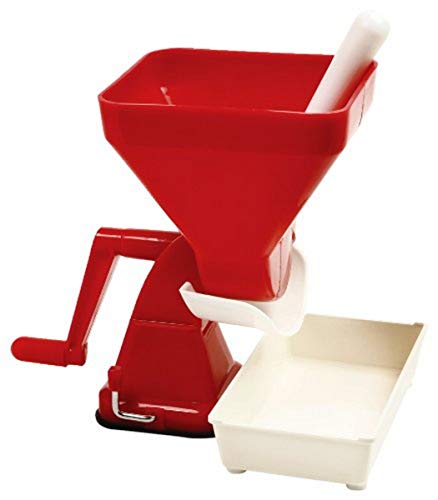
- 2.25-quart hopper for batch processing
- Suction base helps secure it to counters
- Stainless mesh removes seeds, skins, and stems
Best For: Manual countertop canning and sauce preparation
Best Commercial-Style Build
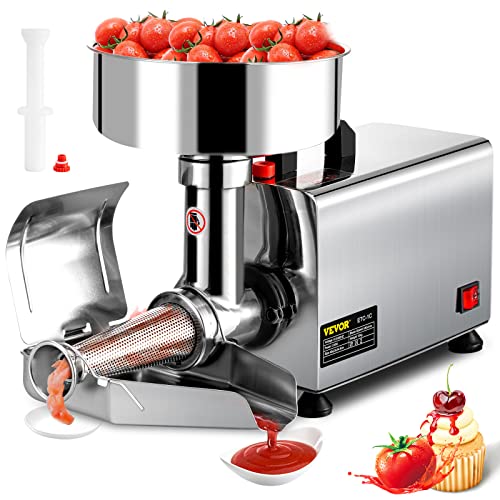
- 370-watt pure copper motor
- 304 stainless steel food-contact parts
- 9-inch funnel with adjustable trough
Best For: High-volume sauce making and dedicated processing spaces
High-Output Stainless Pick

- Processes up to a stated 88 lb per hour
- Includes four screens for varied textures
- 304 stainless parts and splatter-reducing guard
Best For: Harvest-season sauce, puree, and salsa batches
Most Versatile Option
AIRMSEN Meat Grinder and Tomato Press

- Combines tomato pressing with three other functions
- Includes tomato kit and three grinding plates
- Reverse function and non-slip feet aid operation
Best For: Multi-purpose home kitchens and meal prep
Bulk-Processing Specialist

- Rated for up to 200 lb per hour
- Large hopper reduces refill frequency
- Stainless components suit frequent processing
Best For: Bulk sauce making and harvest-season canning
High-Output Italian Press – Reber N.3 Electric Tomato Strainer
For shoppers comparing tomato presses for large batches, the Reber N.3 stands out with a 450W induction motor and a claimed capacity of up to 309 pounds of tomatoes per hour. Its continuous-motor design is suited to harvest-season sauce making and preserves.
Best For: Large-batch home cooks who want a durable electric press for tomato sauce, preserves, jams, and fruit juices.
Pros:
- Processes up to 309 pounds of tomatoes per hour.
- Continuous 450W induction motor with a maintenance-free oil-bath gearbox.
- Cast iron body and AISI 304 stainless steel food-contact components.
- Optional attachments expand its use beyond tomato processing.
Cons:
- At 21 pounds, it is less convenient to move than compact presses.
- Hand washing is recommended.
- Optional attachments are needed for expanded functions.
The Reber is the strongest choice here for very high-volume processing. It costs more space and handling effort than a small manual model, but its continuous operation and Italian-built construction fit serious batch work.
Commercial Manual Mill – Louis Tellier N.5 Stainless Food Mill
This commercial stainless steel food mill is a practical option for tomato presses for large batches when you already have cooked produce and prefer manual control. Its double milling action is rated for up to 11 pounds per minute while holding back skins and seeds.
Best For: Restaurants, caterers, and home cooks processing cooked tomatoes, vegetables, apples, or potatoes over large pots and bowls.
Pros:
- Processes up to 11 pounds, or 5 kilograms, per minute.
- Double milling action presses food against the disc bottom and sides.
- Fits pots and bowls from 10-1/4 to 24 inches in diameter.
- Includes a 3 mm disc, with four additional sizes available separately.
Cons:
- Requires manual operation rather than continuous electric power.
- Additional discs are sold separately.
- Hand washing is recommended.
The Tellier N.5 offers commercial-scale capacity without a motor and gives you flexibility over texture when additional discs are added. It is especially appealing if your workflow already centers on large cooking vessels.
Versatile Electric Option – VEVOR 800W-Max Tomato Strainer
For tomato presses for large batches with adjustable textures, the VEVOR electric strainer combines steady DC-motor operation with multiple screens. It is listed for up to 88 pounds per hour and separates peels and seeds in a single pass.
Best For: Home canners who want an electric machine for tomato sauce, puree, salsa, jam, and pumpkin processing.
Pros:
- Steady, high-torque DC motor is designed for continuous sauce making.
- Includes 1 mm, 1.5 mm, 3 mm, and 6 mm screens.
- 304 stainless steel parts resist fruit acids and wear.
- Removable core components and a cleaning brush simplify cleanup.
Cons:
- Its listed throughput of 88 pounds per hour is lower than the Reber’s claimed capacity.
- The notes list an 800W maximum and 300W rated power, which may require careful comparison.
- At 7.2 pounds, it is lighter but may feel less substantial than heavier commercial designs.
The VEVOR is a flexible middle-ground choice: faster and less labor-intensive than a manual mill, while its four screens make it useful for more than tomatoes. It suits regular batch processing without the footprint of the highest-output press.
Compact Manual Starter – Suction-Mount Tomato Strainer
This compact manual strainer is a simpler entry point for tomato presses for large batches, though its 1.38-kilogram weight and hand-powered design are better suited to modest batches than commercial-volume work. It separates skins and seeds while directing juice into the tray.
Best For: Gardeners and home cooks making fresh salsa, tomato juice, puree, or occasional homemade pasta sauce.
Pros:
- Suction-cup base helps secure the mill during use.
- Separates skins and seeds as juice flows into the tray.
- Includes a stainless steel pusher.
- Compact size and easy-clean design suit home kitchens.
Cons:
- Manual operation is less efficient for truly large batches.
- Plastic construction is less heavy-duty than the stainless steel or cast iron alternatives.
- No throughput rating or multiple screens is listed.
The suction-mount strainer is the budget-friendly, low-complexity pick for seasonal home use. Choose it for occasional garden harvests, but consider an electric or commercial mill if you regularly process large quantities.
Best Electric Pick – Weston Deluxe Electric Tomato Strainer
For tomato presses for large batches, the Weston Deluxe stands out with a 1-gallon hopper and 250-watt motor. Its electric operation, reverse function, and multiple screens make it practical for processing tomatoes, berries, vegetables, and other soft produce for sauces, purees, jellies, and salsa.
Best For: Home preservers who want an electric tomato press for garden harvests or bulk produce.
Pros:
- 1-gallon hopper supports larger batches.
- Two-speed motor includes reverse to help prevent jams.
- Three stainless steel screens handle smooth, multipurpose, and chunky preparations.
- Includes a stomper for safer feeding.
Cons:
- Requires access to a 120-volt power outlet.
- Its plastic and stainless steel construction may not suit buyers seeking an all-metal machine.
The Weston is a well-rounded choice when convenience and batch capacity matter more than manual simplicity. The included screens also give it flexibility beyond standard tomato sauce.
Best Manual Option – Norpro Jumbo Tomato Strainer
Among tomato presses for large batches, the Norpro Jumbo offers a manual alternative with a 2.25-quart hopper and 1.25-quart receiving tray. Its stainless steel mesh separates seeds, skins, and stems while the suction base helps keep the press stable during cranking.
Best For: Canners who prefer manual operation and need a stable countertop press for tomatoes, apples, and sauces.
Pros:
- Large 9-cup hopper helps process substantial amounts of produce.
- Suction base mounts to smooth counters and tables.
- Stainless steel mesh separates seeds, skins, and stems.
- Disassembles quickly and includes a receiving tray, pestle, instructions, and starter recipes.
Cons:
- Manual cranking requires more hands-on effort than an electric model.
- The suction base is intended for smooth surfaces.
The Norpro is a practical choice for buyers who want useful batch capacity without a motor. Its included tray and suction mounting make it convenient for countertop canning preparation.
Best Commercial-Style Build – VBENLEM 370W Tomato Strainer
For tomato presses for large batches with a more commercial-style design, the VBENLEM uses a 370-watt pure copper motor and a 9-inch feeding funnel. Food-contact parts are 304 stainless steel, while the adjustable trough is designed to guide sauce smoothly during processing.
Best For: High-volume sauce making when durable food-contact components and a wide feed funnel are priorities.
Pros:
- 370-watt pure copper motor is built for powered processing.
- Food-contact parts use 304 stainless steel.
- 9-inch funnel supports generous feeding.
- Adjustable trough and brace help direct sauce and reduce splashing.
Cons:
- At 22 pounds, it is less convenient to move than lighter presses.
- The notes do not specify included interchangeable screens.
- Its commercial-style design may be more machine than occasional users need.
The VBENLEM is suited to demanding processing sessions where motor power, stainless food-contact parts, and feeding capacity take priority. Its heavier construction favors a dedicated workspace over frequent storage and setup.
High-Output Stainless Pick – VEVOR 800W Tomato Strainer
For tomato presses for large batches, this VEVOR model emphasizes steady operation, stainless-steel components, and a stated capacity of up to 88 lb per hour for purees. Its multiple screens also make it useful when you want more than one sauce or puree texture.
Best For: Home cooks processing harvest-season tomatoes, puree, salsa, jam, or pumpkin in repeated batches.
Pros:
- Separates peels and seeds in a single pass for smoother sauce, puree, and juice.
- Includes four screens measuring 1 mm, 1.5 mm, 3 mm, and 6 mm for different textures.
- 304 stainless-steel parts resist fruit acids and wear, while core components remove without tools.
- Guard cover helps reduce splatter, and a cleaning brush is included.
Cons:
- The unit weighs 7.2 pounds, so it is less lightweight than a manual press.
- Its listed rated power is 300W, despite the 800W maximum in the title.
This is a versatile choice when batch tomato processing is the priority but you also want interchangeable screens for other foods. The stainless construction and guard cover support frequent use, while the included brush simplifies cleanup.
Most Versatile Option – AIRMSEN Meat Grinder and Tomato Press
If you need tomato presses for large batches but also want a broader kitchen appliance, the AIRMSEN combines tomato straining with meat grinding, sausage making, and kibbeh preparation. Its motor is designed for high-throughput ingredient processing, though the tomato function is part of a multi-purpose system rather than a dedicated press.
Best For: Home kitchens that want one machine for tomato sauce, ground meat, sausage, and kibbeh preparation.
Pros:
- Combines four functions: meat grinding, sausage making, kibbeh preparation, and tomato processing.
- Includes a tomato strainer kit plus 5 mm, 7 mm, and 12 mm grinding plates.
- Reverse function helps clear jams, while non-slip feet improve stability.
- Detachable parts make disassembly straightforward, and a safety lock secures the assembly.
Cons:
- It is not dishwasher safe; hand washing is recommended.
- Its listed wattage is 300W, so the 2500W peak-power claim should not be treated as continuous operating power.
- The added functions may be unnecessary if you only need a dedicated tomato press.
The AIRMSEN makes the most sense for cooks who value versatility over a tomato-only design. Its reverse function and stable base are useful during processing, but cleanup and the multi-function format are important considerations.
Bulk-Processing Specialist – VEVOR 370W Food Mill
For tomato presses for large batches, this VEVOR food mill is built around high-volume processing. Its 370W motor, large hopper, and stated output of up to 200 lb per hour are aimed at harvest-season sauce making and bulk canning, while the stainless-steel food-contact components support frequent use.
Best For: Large harvests, bulk tomato sauce, puree, jam, and repeated canning sessions.
Pros:
- Stated processing capacity reaches 200 lb per hour.
- Large hopper reduces the need for frequent refills during high-volume work.
- Stainless-steel hopper, filter screen, juice tray, and guard are designed to withstand fruit acids and wear.
- Core components disassemble without tools for quick rinsing.
Cons:
- The 21.7-pound weight makes it less convenient to move and store.
- Tomatoes should be cut into small pieces first to help reduce clogging.
- The larger footprint may require more dedicated counter or storage space.
This is the strongest fit for shoppers focused on throughput rather than compactness. The large hopper and 200-lb-per-hour specification favor serious batch processing, while tool-free disassembly helps keep cleanup manageable after canning days.
How We Picked the Best Tomato Presses for Large Batches
We focused on machines designed to process more than occasional single-bowl quantities. The selection includes electric tomato strainers, commercial food mills, and manual presses with features suited to garden harvests, canning, sauce production, and other repetitive work.
Our comparison emphasizes motor output, stated processing capacity, construction, auger and screen design, operating convenience, and cleanup. Because manufacturers may describe capacity differently, treat published pounds-per-hour or kilograms-per-hour figures as reference points rather than guaranteed results. Tomato variety, ripeness, preparation, and screen condition all affect throughput.
Quick Comparison
Electric models are generally the fastest choice for large harvests and reduce the physical effort required to feed tomatoes through the press. Higher-powered commercial-style machines can be useful when processing several batches consecutively, but they usually cost more and need more storage space. Manual models are slower, yet they can be practical for users who value simple operation, lower cost, and no motor to maintain.
When comparing the products above, check whether a listed wattage is maximum or rated power, and look for the included screen, hopper, collection tray, clamps, and pulp or seed outlet. A model with a lower headline wattage may still suit home use if its design feeds fruit efficiently.
Key Buying Factors for Tomato Presses for Large Batches
Motor Power and Real Throughput
For repeated processing, choose a motor intended for extended use and a feed system that is unlikely to clog. Capacity ratings are helpful, but a stable workflow and easy refeeding often matter more than the largest advertised number.
Materials and Stability
Stainless steel or durable food-contact components are easier to keep clean and better suited to frequent use. A secure clamp, nonslip base, or sturdy frame prevents the machine from shifting as you work through heavy batches.
Screen and Separation Quality
The screen should remove skins and seeds without wasting excessive pulp. Confirm that replacement screens or compatible accessories are available if you plan to process different tomato varieties or other soft produce.
Cleaning and Maintenance
Look for removable parts, accessible augers, and dishwasher-safe components where specified. Rinse pulp promptly, dry metal parts thoroughly, and follow the manufacturer’s instructions for lubrication and motor care.
Batch Size and Workspace
Measure your counter, storage area, and outlet location before buying. A large hopper and high-capacity motor are useful only if you have room to safely stage tomatoes, sauce containers, and waste pulp.
Who Should Buy Which Tomato Presses for Large Batches?
Choose an electric press if you process bushels of tomatoes, make sauce regularly, or want to minimize hand cranking. It is the most convenient option for sustained, high-volume work.
Choose a commercial-style stainless steel model if durability, stability, and repeated seasonal use matter more than compact storage or the lowest upfront price.
Choose a manual jumbo strainer if your batches are moderate, electricity is unavailable, or you prefer a simpler appliance with fewer mechanical parts.
Choose a compact sauce maker if you want tomato pressing alongside general kitchen tasks and need a machine that is easier to store. Before purchasing, verify the manufacturer’s capacity claims, included accessories, warranty, and replacement-part availability.