Small food businesses need straining equipment that can keep pace with production without creating unnecessary cleanup, waste, or bottlenecks. The right machine can separate skins, seeds, and pulp efficiently for sauces, juices, purées, and preserves.
This roundup compares 10 options ranging from commercial electric tomato mills to compact stainless-steel strainers, helping you match capacity, power, construction, and workflow to your operation.
Best 10 Food Strainer Machines for Small Businesses Picks for 2026
Commercial Sauce Processing Pick
VBENLEM Electric Tomato Strainer
- 370W motor for tomato and fruit sauce processing
- 304 stainless-steel food-contact components
- Large funnel and adjustable discharge trough
Best For: Small sauce makers and produce processors
Small-Batch Fine Mesh Pick

- Extra-fine mesh for liquids and small ingredients
- Durable 18/8 stainless-steel construction
- Dishwasher safe and compact
Best For: Cafes, bakeries, bars, and light prep
Versatile Produce Milling Pick

- Electric motor plus manual hand-crank operation
- Separates skins and seeds from produce
- Includes 1.3 mm apple/tomato screen
Best For: Small producers making sauces, purees, and jams
Everyday Prep Pick
Gulex 3-Quart Stainless Colander

- 3-quart size for small kitchens and food trucks
- Closely spaced holes drain quickly
- 304 stainless-steel construction
Best For: Routine rinsing and draining of kitchen ingredients
Harvest Batch Workhorse
VEVOR 370W Electric Tomato Strainer

- 370W motor and large hopper for batch processing
- Stainless screen separates pulp, peels, and seeds
- Tool-free disassembly supports faster cleanup
Best For: Small sauce businesses and seasonal canning
High-Throughput Commercial Pick

- Stated capacity reaches up to 330 pounds per hour
- 304 stainless steel body with automatic separation
- Five-year warranty and lifetime customer support
Best For: Restaurants, farms, and commercial kitchens
Texture-Focused Compact Option

- Four screens support varied sauce and puree textures
- 304 stainless steel parts with tool-free removal
- Light 7.2-pound design and splatter-reducing guard
Best For: Small producers making varied sauces, jams, and purees
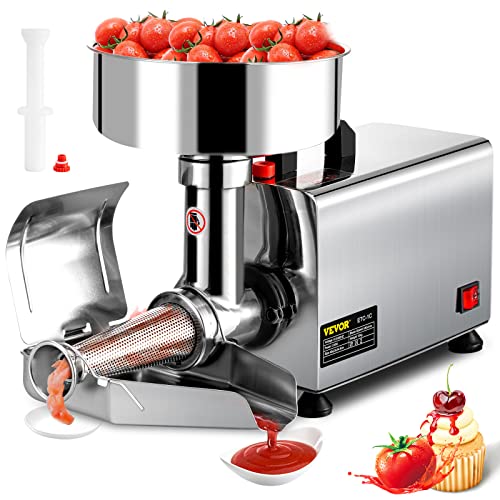
High-Output Pick
ETC-1C Electric Tomato Strainer

- 200–350 lb/h stated output
- 304 stainless-steel food-contact parts
- Tool-free, dishwasher-safe detachable components
Best For: Small commercial kitchens and high-volume canning
Versatile Screen Pick
VEVOR Electric Tomato Strainer

- Four screens for varied textures
- 88 lb/h stated puree capacity
- Guard helps reduce juice splatter
Best For: Small businesses making varied sauces, jams, and purees
Commercial Value Pick

- 450W motor with 110 lb/h stated capacity
- 8.4-inch stainless-steel funnel
- Motor casing and pestle support safer operation
Best For: Dessert shops and fruit markets making sauces and jams
Commercial Sauce Processing Pick – VBENLEM Electric Tomato Strainer
For small businesses needing food strainer machines for small businesses, the VBENLEM electric tomato strainer is designed for higher-volume sauce and puree preparation. Its 370W motor, stainless-steel food-contact parts, adjustable trough, and large funnel make it a practical choice for processing tomatoes and soft fruit.
Best For: Small sauce makers, farm stands, and food businesses processing tomatoes, berries, and other produce into sauces or jams.
Pros:
- 370W pure copper motor with a stated processing capacity of 90–160 kg/h.
- 304 stainless-steel food-contact parts and a stainless-steel outer casing.
- Adjustable discharge trough and 9-inch funnel support smoother feeding and output.
- Designed for relatively quiet operation and easier cleaning.
Cons:
- Its 110V electric design requires access to a suitable outlet.
- At 22 pounds, it is less portable than compact manual strainers.
- It is specialized primarily for tomato milling and sauce making.
This is the strongest throughput-oriented option in the group. Choose it when regular sauce production matters more than compact storage or multipurpose countertop straining.
Small-Batch Fine Mesh Pick – RSVP Endurance Conical Sieve
For businesses that need food strainer machines for small businesses for light-duty prep, the RSVP Endurance conical sieve offers a compact manual solution. Its extra-fine stainless-steel mesh is suited to small quantities of liquids, loose ingredients, and cooked foods.
Best For: Cafes, bakeries, bars, and small kitchens handling broth, tea, juice, sauces, or other smaller straining jobs.
Pros:
- Extra-fine mesh helps strain broth, juice, tea, and other small particles.
- Durable 18/8 stainless-steel construction with a polished rim and handle.
- Dishwasher safe for straightforward cleanup.
- Compact 4.75-inch diameter suits smaller batches and limited storage space.
Cons:
- Manual operation is not intended for high-volume processing.
- The small basket limits batch size.
- It does not separate produce skins and seeds like a dedicated sauce mill.
This sieve is a useful low-cost complement to a small commercial kitchen rather than a production machine. It makes the most sense when precision straining and easy washing are more important than speed.
Versatile Produce Milling Pick – Johnny Apple Sauce Maker
The Johnny Apple Sauce Maker is a flexible choice among food strainer machines for small businesses that need to remove skins and seeds from multiple types of produce. It combines a clamp-mounted body with an included electric motor, while also allowing hand-crank operation.
Best For: Small producers making applesauce, tomato sauce, purees, jams, juices, pie fillings, soups, or baby food.
Pros:
- Handles purees, sauces, juices, jams, pie fillings, and more.
- Included electric motor can be used alongside the manual hand crank.
- Apple/tomato screen has 1.3 mm holes for separating skins and seeds.
- Cast aluminum body, stainless-steel screens, and a stated five-year warranty.
Cons:
- Clamp mounting requires a countertop between 3/4 and 2-1/8 inches thick.
- Its clamp-based setup may be less convenient for frequent repositioning.
- The listed screen and spiral configuration may require additional setup for different produce.
This model offers a useful balance of electric assistance and manual control. It is a good fit when product variety and skin-and-seed separation matter more than the capacity of a commercial floor machine.
Everyday Prep Pick – Gulex 3-Quart Stainless Colander
For basic draining and rinsing, the Gulex colander is a simple alternative to powered food strainer machines for small businesses. Its 3-quart capacity, closely spaced holes, footed base, and 304 stainless-steel construction suit routine prep in food trucks, small restaurants, and shared kitchens.
Best For: Small restaurants and food trucks draining pasta, vegetables, berries, potatoes, and other everyday ingredients.
Pros:
- 3-quart capacity is sized for smaller kitchen operations.
- Closely spaced holes drain quickly while helping retain smaller foods such as spaghetti.
- Professional-grade 18/10, 304 stainless steel is rust resistant and designed not to affect food taste.
- Footed design and solid ring base help support stable, fast drainage.
Cons:
- It is a basic colander, not a machine for milling or separating seeds and skins.
- Manual draining limits throughput for larger production tasks.
- Its 3-quart capacity may be too small for high-volume batches.
This is the most practical choice for routine rinsing and draining rather than sauce production. Select it when durability and a compact footprint are priorities for everyday ingredient prep.
Harvest Batch Workhorse – VEVOR 370W Electric Tomato Strainer
For small businesses seeking food strainer machines for small businesses, this VEVOR model is designed for frequent tomato sauce, puree, juice, jam, and fruit-processing work. Its 370W motor, large hopper, and stainless steel separation screen support efficient batch processing while keeping cleanup manageable.
Best For: Small sauce businesses, seasonal canning operations, and users processing large batches of tomatoes.
Pros:
- Stainless steel screen separates peels and seeds in one pass.
- Large hopper and 370W motor support high-volume processing.
- Core components disassemble without tools for quick rinsing.
- Stainless steel hopper, tray, screen, and guard resist fruit acids and wear.
Cons:
- Tomatoes should be cut into small pieces to help reduce clogging.
- At 21.7 pounds, it is less convenient to move frequently.
This is a practical choice when throughput and straightforward maintenance matter more than portability. Its single-screen setup is especially suitable for businesses focused on smooth tomato products and repeat harvest-season processing.
High-Throughput Commercial Pick – ARINOO 450W Tomato Strainer
Among food strainer machines for small businesses, the ARINOO stands out for its stated capacity of up to 330 pounds per hour and automatic dual-channel separation. The 450W pure copper motor, 304 stainless steel construction, and included safety features make it suited to demanding sauce, jam, and puree preparation.
Best For: Restaurants, farms, commercial kitchens, and small businesses needing higher stated processing capacity.
Pros:
- Processes up to 330 pounds per hour according to the supplied specifications.
- Dual-channel design automatically separates seeds and skins without an extra filtering step.
- Food-grade 304 stainless steel construction is rust-resistant.
- Includes a safety guard, enclosed motor housing, food pusher, five-year warranty, and lifetime support.
Cons:
- Requires a five-minute cooldown after every 15 minutes of continuous use.
- Hand-wash care is specified, which may add cleanup time.
- Ingredients should be cut smaller, and firmer fruits such as apples may need cooking first.
The ARINOO is compelling for operators who prioritize stated throughput, support, and warranty coverage. Its cooldown requirement is important to include in workflow planning, particularly during extended production runs.
Texture-Focused Compact Option – VEVOR 800W Max Sauce Maker
This VEVOR model gives small businesses using food strainer machines for small businesses more flexibility over finished texture. Along with pulp-and-seed separation, it includes four screens for products such as tomato sauce, strawberry jam, pumpkin puree, and salsa, while its compact 7.2-pound design is easier to handle than the larger machines here.
Best For: Small producers making varied sauces, jams, purees, and salsa in smaller or more texture-specific batches.
Pros:
- Includes four screens measuring 1mm, 1.5mm, 3mm, and 6mm for different textures.
- 304 stainless steel components resist fruit acids and wear.
- DC motor provides steady, high-torque, low-noise operation for continuous sauce making.
- Tool-free component removal and an included cleaning brush simplify rinsing.
Cons:
- The supplied item highlight lists 88 pounds per hour, lower than the other listed machines.
- Recommended uses are listed as mincing, so buyers should confirm their intended workflow.
- Its 40 kg capacity may be less suitable for very large production runs.
This is the most adaptable option for businesses that sell products with different consistencies. It trades the higher listed throughput of the other models for multiple screens, a lighter build, and a guard cover that helps reduce splatter.
High-Output Pick – ETC-1C Electric Tomato Strainer
For small businesses needing food strainer machines for small businesses, this 450W electric tomato press is designed for substantial batches of tomatoes, berries, and soft fruits. Its stated 200–350 lb/h output, 8.5-inch feed chute, and stainless-steel food-contact parts make it suited to sauce, jam, and juice production.
Best For: Small commercial kitchens, farm stands, and canners processing large batches.
Pros:
- Rated output of 200–350 lb/h for high-volume processing.
- 304 stainless-steel food-contact components resist corrosion and help maintain clean flavors.
- Tool-free assembly, dishwasher-safe detachable parts, and an enclosed motor guard simplify use and cleanup.
- Wide feed chute and adjustable trough support continuous feeding with less splashing.
Cons:
- At 20.9 pounds, it is less convenient to move than smaller machines.
- The listed output and capacity may be more than occasional users need.
This is the strongest fit when throughput is the priority. Buyers should confirm that the 110V electrical specification and larger footprint suit their workspace.
Versatile Screen Pick – VEVOR Electric Tomato Strainer
This VEVOR model is one of the more versatile food strainer machines for small businesses, using interchangeable screens to adjust textures for tomato sauce, jam, puree, salsa, and juice. Its stainless-steel construction, steady DC motor, and splatter-reducing guard support repeated batch processing.
Best For: Small food businesses that need multiple puree and sauce textures from one machine.
Pros:
- Includes four screens in 1mm, 1.5mm, 3mm, and 6mm sizes for different preparations.
- Stainless-steel filter separates peels and seeds in a single pass.
- DC motor is described as steady, high-torque, and low-noise for continuous work.
- Removable core components and the included cleaning brush support easier rinsing.
Cons:
- The stated processing rate is 88 lb/h, lower than the higher-output models in this group.
- The listing gives both an 800W maximum and 300W rated power, so buyers should interpret the power claims carefully.
Choose this machine when texture flexibility matters more than maximum throughput. Its 7.2-pound weight may also appeal to businesses that need a comparatively portable setup.
Commercial Value Pick – Newhai ETC-1C Sauce Maker
The Newhai ETC-1C offers a practical entry point for food strainer machines for small businesses, with a 450W motor, an 8.4-inch stainless-steel funnel, and a stated capacity of up to 110 pounds of jam per hour. It is intended for tomatoes and fruits such as strawberries and blueberries, making it useful for sauce and fruit-processing work.
Best For: Dessert shops, fruit markets, and small commercial kitchens seeking straightforward batch processing.
Pros:
- Large 8.4-inch funnel accommodates substantial amounts of raw material.
- 450W motor and stated 110 lb/h capacity support regular batch production.
- Motor casing and included pestle provide added operating protection compared with exposed-motor designs.
- Parts are designed to disassemble quickly for rinsing and storage.
Cons:
- Product care instructions specify hand washing only.
- The motor must be kept out of the water during cleaning.
- The supplied notes do not list interchangeable screens for different textures.
This is a sensible choice for businesses focused on basic tomato sauce and fruit-jam production. Its relatively simple design favors routine operation, while hand washing requires more cleanup attention.
How We Picked the Best Food Strainer Machines for Small Businesses
We focused on equipment that can support real kitchen or small-production workflows, prioritizing stated throughput, motor power, material quality, ease of cleaning, and the types of produce each option can process. The selection includes powered tomato mills for higher-volume sauce production as well as manual and stainless-steel strainers for bakeries, cafés, caterers, and businesses that need flexibility rather than maximum speed.
Because listed capacities can vary by produce type, preparation, and operating conditions, treat manufacturer ratings as useful benchmarks rather than guaranteed output. Build quality, replacement parts, and the availability of practical accessories also matter when equipment will be used regularly.
Quick Comparison
| Best For | Look For | Typical Advantage |
|---|---|---|
| High-volume tomato processing | Electric motor, durable hopper, high stated capacity | Faster sauce and purée production |
| Small batches and varied prep | Manual operation or fine mesh | Lower cost and greater control |
| Commercial kitchen flexibility | Stainless steel construction and dishwasher-safe parts | Easier cleaning and broader everyday use |
| Limited counter space | Compact clamp or countertop design | Simple storage and setup |
Key Buying Factors for Food Strainer Machines for Small Businesses
Capacity and Throughput
Estimate your busiest production period, not your average day. Electric mills rated around 90–200 pounds per hour may suit sauce makers and farm stands, while a manual sieve can be more practical for occasional batches. Avoid paying for industrial capacity if your available prep space and staff cannot support it.
Motor Power and Produce Type
Motor wattage offers a rough indication of operating strength, but it is not the only performance measure. Tomatoes, berries, cooked vegetables, and apples behave differently. Confirm that the screen, auger, and feed system are suitable for the produce you plan to process, and check whether hard or fibrous ingredients require pre-cooking or chopping.
Materials, Cleaning, and Safety
Stainless steel components resist stains and are generally easier to sanitize. Look for removable food-contact parts, accessible screens, stable feet or clamps, and clear operating instructions. Verify which pieces are dishwasher safe; the motor housing should never be immersed. Overload protection, secure locking, and a reliable on/off switch are especially valuable during repeated commercial use.
Space, Noise, and Maintenance
Measure counter depth, outlet access, storage space, and the clearance needed to place a bowl beneath the outlet. Powered machines are faster but typically louder and more demanding to maintain. Before buying, check replacement-screen availability, warranty coverage, and whether commonly worn parts can be ordered separately.
Who Should Buy Which Food Strainer Machines for Small Businesses?
Choose a commercial electric mill if your business regularly processes tomatoes or soft produce in large batches and labor savings are important. Choose a manual or clamp-based strainer for lower-volume production, mobile catering, or businesses that value low upfront cost and straightforward maintenance. Choose a fine-mesh conical sieve or stainless-steel colander when you need an adaptable tool for baking, draining, finishing sauces, and occasional straining rather than a dedicated tomato-processing machine.
For most buyers, the best choice balances peak volume with cleanup time, available space, and long-term parts support—not simply the highest advertised wattage or capacity.