Automatic continuous band sealers can close bags faster and more consistently than handheld heat sealers, making them useful for food, retail, fulfillment, and light industrial packaging.
This roundup compares 10 models across sealing control, bag compatibility, operating orientation, coding features, and day-to-day usability so you can choose the right machine for your workflow.
Best 10 Automatic Continuous Band Sealers Picks for 2026
High-Speed Horizontal Pick
Happybuy FR-900 Continuous Band Sealer

- Reaches up to 52.49 ft/min
- 6–12 mm adjustable seal width
- Supports embossing and alphanumeric printing
Best For: Flexible horizontal sealing for small businesses and workshops
Large-Workspace Workhorse
VONPACK FR-900 Automatic Band Sealer

- 0–300°C temperature range
- Seals bags up to 0.80 mm thick
- Extended conveyor for batch work
Best For: Higher-volume food and general packaging applications
Precision Material Specialist
JORESTECH CBS-730I Band Sealer

- PID digital temperature control
- Supports many thermoplastic materials
- Horizontal or vertical operation
Best For: Precise light-duty sealing of varied pouch and bag materials
Integrated Coding Pick
VEVOR PM1800 Continuous Bag Sealer
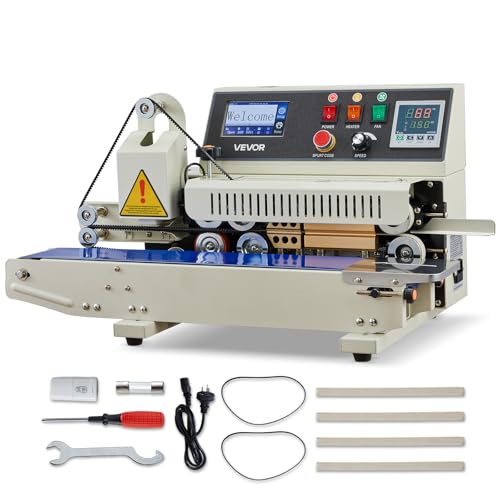
- Prints codes, dates, logos, and QR codes
- Built-in sealed-bag counter
- Reaches up to 52.5 ft/min
Best For: Packaging workflows requiring coding and production counts
Precision Benchtop Sealer
U.S. Solid Horizontal Band Sealer

- 0–300°C digital temperature control
- Sealing speeds up to 12 m/min
- Handles films from 0.02–0.5 mm
Best For: Lightweight pouches and small-to-medium packaging runs
Coder-Ready Workhorse
FR-900 Automatic Horizontal Sealer
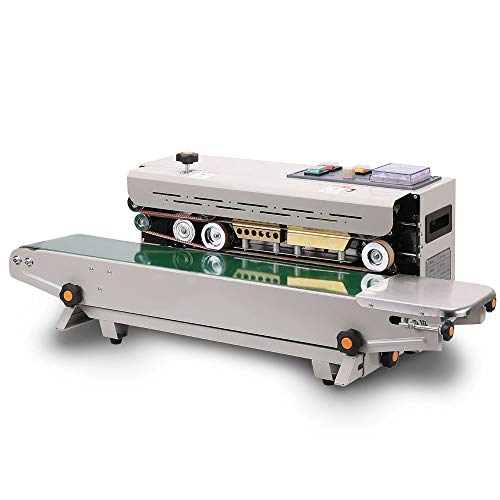
- Prints dates, times, and remarks while sealing
- Adjustable conveyor and 0–12 m/min speed
- Supports bags up to 5 kg
Best For: Packaging lines needing sealing and basic product coding
Compact Safety Pick
Desktop Continuous Band Sealer

- 0–250°C digital temperature control
- 7 m/min sealing speed with 6–10 mm seal width
- 11-pound compact desktop design
Best For: Small workspaces sealing food and general-purpose bags
Best Overall
VEVOR FR900K Continuous Band Sealer

- Adjustable speed up to 16 m/min
- Integrated date, remark, and logo printing
- All-metal body with conveyor and cooling blocks
Best For: Versatile production sealing with package printing
Best Desktop Option
Commercial FRC-520 Heat Sealer

- Compact 23-pound desktop design
- Fast heating up to 300°C
- Built-in 6-inch conveyor and adjustable speed
Best For: Small-business and home packaging tasks
Best With Counter
U.S. SOLID Vertical Band Sealer

- Built-in counter tracks packing output
- Prints dates, comments, and logos
- Copper heating and cooling blocks
Best For: Packing workflows that need counting and coding
High-Speed Horizontal Pick – Happybuy FR-900 Continuous Band Sealer
For shoppers comparing automatic continuous band sealers, the Happybuy FR-900 stands out for its adjustable sealing width, automatic operation, and production speed of up to 52.49 feet per minute. Its metal construction and included spare parts make it practical for recurring packaging work.
Best For: Small businesses, workshops, and household users needing flexible horizontal bag sealing with optional embossing or alphanumeric printing.
Pros:
- Seals at speeds up to 0–16 meters per minute.
- Adjustable sealing width from 6 to 12 mm.
- Supports embossing and alphanumeric printing.
- Includes toothed belts, Teflon belts, a fuse, and other accessories.
Cons:
- The listed dimensions make it a fairly substantial 33-inch-long machine.
- Its 110V electrical configuration may not suit every workspace.
The FR-900 is a versatile choice when you want automatic continuous sealing plus basic coding capabilities. Its adjustable controls and maintenance accessories add convenience for ongoing packaging tasks.
Large-Workspace Workhorse – VONPACK FR-900 Automatic Band Sealer
The VONPACK FR-900 is one of the automatic continuous band sealers to consider when batch work and workspace capacity matter. It combines 0–300°C temperature control, adjustable speed, and an extended conveyor platform for handling larger-volume items.
Best For: Batch sealing of food, snack, plastic, and aluminum foil bags in kitchens, shops, and production areas.
Pros:
- Temperature adjusts from 0 to 300°C for different bag materials.
- Handles bag thicknesses from 0.02 to 0.80 mm.
- Offers 0–12 meters-per-minute sealing speed and 6–12 mm seal width.
- Extended conveyor platform supports larger-volume items.
Cons:
- The 32.28-inch-long body requires dedicated counter or floor space.
- Its 5 kg conveyor load limit may restrict heavier packages.
With a broad temperature range and generous conveyor area, this VONPACK model is geared toward repeated batch sealing. It is especially appealing if you need more working room than a compact bag sealer provides.
Precision Material Specialist – JORESTECH CBS-730I Band Sealer
The JORESTECH CBS-730I is a strong option among automatic continuous band sealers for users who prioritize precise temperature settings and material compatibility. Its PID digital controller and stainless-steel construction support light-duty continuous sealing in horizontal or vertical applications.
Best For: Light-duty industrial sealing of PE, PP, BoPET, heat-sealable laminations, and cellulose bags, including stand-up and gusseted pouches.
Pros:
- PID digital temperature control helps fine-tune sealing parameters.
- Works with a wide range of thermoplastic materials and heat-sealable laminations.
- Handles stand-up pouches, gusseted bags, pillow bags, sachets, and barrier bags.
- Stainless-steel construction suits demanding packaging environments.
Cons:
- It is listed as semi-automatic rather than fully automatic.
- At 60 pounds, it is considerably heavier than the other listed options.
- The supplied notes describe it as intended for light-duty applications.
This JORESTECH model makes the most sense when seal precision and broad bag-material compatibility outweigh portability. Its digital control is a useful advantage for packaging materials that require carefully managed heat.
Integrated Coding Pick – VEVOR PM1800 Continuous Bag Sealer
The VEVOR PM1800 combines automatic continuous sealing with printing and counting functions, making it a practical choice for businesses that need more than a basic heat seal. It offers adjustable temperature and speed, a 6–12 mm seal width, and speeds up to 52.5 feet per minute.
Best For: Warehouses, bakeries, shops, and workshops that want to seal bags while adding dates, numbers, logos, barcodes, or QR codes.
Pros:
- Prints text, dates, numbers, logos, barcodes, and QR codes.
- Built-in counter records sealed bags in real time.
- Temperature adjusts from 32 to 572°F, with speed control for setup flexibility.
- Includes spare gear belts, PTFE-coated conveyor belts, a fuse, and tools.
Cons:
- Ink is sold separately.
- The 120V configuration may require attention to outlet compatibility.
- Its sheet-metal painted construction is less specialized than stainless steel.
The PM1800 is particularly compelling when traceability and production tracking are part of the packaging workflow. The separate ink purchase is worth factoring in, but the integrated printer and counter can reduce the need for additional equipment.
Precision Benchtop Sealer – U.S. Solid Horizontal Band Sealer
For buyers comparing automatic continuous band sealers for small- to medium-sized packages, this U.S. Solid model stands out for its digital temperature control and adjustable conveyor speed. It creates a 10 mm seal on PVC, PE, foil, Mylar, coffee, and stand-up pouches up to 1 kg.
Best For: Small businesses and workspaces sealing lightweight food, cosmetic, tea, spice, or pharmaceutical pouches.
Pros:
- Digital temperature adjustment from 0–300°C for different film types.
- Adjustable sealing speed up to 12 m/min with a separate speed dial.
- All-metal construction with pure copper heating and cooling blocks.
- Compact 110V benchtop design supports 0.02–0.5 mm films.
Cons:
- Intended for bags up to 1 kg, so it is not suited to heavy sacks.
- Horizontal operation may be less convenient for liquid-filled packages.
This is a strong choice when precise heat control and repeatable throughput matter more than maximum bag capacity. Its compact format fits smaller production areas, while the stated weight limit keeps its use focused on lightweight packaging.
Coder-Ready Workhorse – FR-900 Automatic Horizontal Sealer
The FR-900 is one of the more versatile automatic continuous band sealers for packaging operations that need sealing plus basic marking. Its adjustable conveyor, constant-temperature control, embossing system, and date-printing capability support a range of bags up to 5 kg.
Best For: High-volume packaging tasks involving plastic, kraft paper, composite-film, or aluminum-foil bags that may need dates or remarks printed during sealing.
Pros:
- Embosses sealing patterns and can print dates, times, and remarks.
- Adjustable sealing speed from 0–12 m/min.
- Conveyor angle adjusts to accommodate different bag sizes.
- Metal spray-painted body and modular internal assembly simplify maintenance.
Cons:
- Designed for bags no thicker than 0.08 mm.
- Despite the stated lack of a width limit, bag weight should remain at or below 5 kg.
- The 500-watt unit may require more power than compact desktop alternatives.
Choose this model when integrated coding and flexible bag positioning are more valuable than a broad thickness range. Its 5 kg weight allowance is useful, but material compatibility should be checked carefully because the listed thickness limit is relatively narrow.
Compact Safety Pick – Desktop Continuous Band Sealer
This compact desktop machine is a practical option among automatic continuous band sealers for users who want straightforward controls and a smaller footprint. Its digital panel adjusts temperature from 0–250°C, while the conveyor runs at 7 m/min and supports 6–10 mm seals.
Best For: Home businesses, kitchens, and small work areas sealing food, foil, kraft paper, or CPP bags containing solids or liquids.
Pros:
- Full-wrap, heat-insulated shell helps reduce burn and pinch risks.
- Digital temperature control is designed for simple adjustment.
- Compact 7 × 6.3 × 14-inch footprint and 11-pound weight improve portability.
- Supports adjustable 6–10 mm seal widths.
Cons:
- Fixed listed sealing speed of 7 m/min is slower than models reaching 12 m/min.
- Temperature tops out at 250°C, below some competing models.
- Users need to test each material and thickness to avoid weak or overheated seals.
This sealer makes the most sense where portability, user-friendly controls, and added exterior protection are priorities. It is less suited to buyers seeking maximum speed or the widest possible temperature range, but its desktop design is convenient for lighter-duty packaging.
Best Overall – VEVOR FR900K Continuous Band Sealer
For higher-volume packaging lines, the VEVOR FR900K is a capable choice among automatic continuous band sealers. It combines adjustable sealing speed, digital temperature control, a conveyor, and an integrated printing function for production workflows that need both sealing and basic package marking.
Best For: Businesses sealing plastic, foil, composite, or paper bags that need adjustable throughput and date or logo printing.
Pros:
- Adjustable speed up to 16 m/min and sealing width from 6–15 mm.
- Supports bag materials from plastic and aluminum foil to composite and paper.
- Embossing and type wheels can print dates, remarks, introductions, or logos while sealing.
- All-metal construction, copper motor, conveyor, and cooling/heating blocks support repeated operation.
Cons:
- At 21.85 inches long and 750 watts, it requires a substantial workspace and power supply.
- The printing accessories may require setup and adjustment for different marking needs.
Its broad material range and printing capability make the FR900K particularly versatile. Choose it when integrated coding and higher adjustable speed matter more than a compact desktop footprint.
Best Desktop Option – Commercial FRC-520 Heat Sealer
The FRC-520 is a practical desktop pick for small businesses and home operations seeking automatic continuous band sealers. Its speed control, fast-heating copper element, adjustable sealing width, and built-in conveyor provide straightforward control for everyday bag-sealing tasks.
Best For: Small businesses and home users sealing lightweight plastic, foil, composite, or paper bags.
Pros:
- Speed control knob lets users adjust the sealing process for different bags.
- Adjustable 6–12 mm sealing width accommodates a range of bag sizes.
- Heats up in seconds and reaches temperatures up to 300°C.
- Built-in 6-inch conveyor supports smooth material feeding.
Cons:
- Its supported bag thickness is limited to 0.02–0.16 mm.
- It has a lower 500-watt rating and slower maximum speed than the VEVOR FR900K.
With a 23-pound metal body and relatively compact dimensions, this model balances stability with desktop usability. It is a sensible choice when you need adjustable continuous sealing without the larger capacity or printing features of a production-oriented machine.
Best With Counter – U.S. SOLID Vertical Band Sealer
The U.S. SOLID model stands out among automatic continuous band sealers for its built-in counter and coding capability. Its digital temperature control, simple dial-based operation, copper heating and cooling blocks, and stated 0–12 m/min speed range make it suited to organized packing workflows.
Best For: Operators who want continuous bag sealing with package marking and a running packing count.
Pros:
- Built-in counter helps track packing output.
- Embossing and type wheels can print dates, comments, and logos during sealing.
- Temperature range extends from 0–572°F, with speed adjustable up to 12 m/min.
- All-metal body with pure copper heating and cooling blocks is designed for repeated use.
Cons:
- Listed operation mode is semi-automatic rather than fully automatic.
- Its maximum supported load-bearing object weight is 6.6 pounds.
- The product notes do not specify a conveyor width or sealing width.
The counter is the key differentiator here, especially for users monitoring packing quantities. Consider it when counting and coding are more valuable than fully automatic operation or detailed conveyor specifications.
How We Picked the Best Automatic Continuous Band Sealers
We focused on the features that most affect real-world packaging performance: sealing temperature and speed controls, supported bag materials and thicknesses, horizontal or vertical operation, seal width, construction, portability, and whether the machine includes date or batch coding. We also considered how clearly each model is suited to desktop, commercial, or more demanding production use.
Because specifications can vary by seller and configuration, confirm the listed voltage, maximum bag thickness, sealing direction, and included accessories before ordering. A machine advertised as a similar FR-900 model may still differ in controller, conveyor design, or printing capability.
Quick Comparison
- Best for general horizontal sealing: FR-900-style desktop machines with adjustable temperature and speed.
- Best for vertical applications: Vertical-capable sealers such as the JORESTECH CBS-730I or U.S. Solid vertical model.
- Best for printed packaging: Models that include an ink-printing or coding attachment.
- Best for frequent commercial use: Machines with sturdy frames, digital controls, continuous-duty motors, and accessible replacement parts.
- Best for compact workspaces: Desktop units with horizontal operation and a simple control panel.
Key Buying Factors for Automatic Continuous Band Sealers
Bag Material and Thickness
Check whether the sealer supports polyethylene, polypropylene, laminated films, PVC, or other materials used in your packaging. Thickness limits are equally important: a model rated for thin bags may not seal heavier laminated pouches reliably.
Horizontal Versus Vertical Operation
Horizontal sealers work well with stable, flat products. Vertical machines are better when contents are liquid, granular, or bulky and could spill if laid on their side. Some units support both orientations, but verify how conversion works and whether the conveyor remains practical in each position.
Temperature, Speed, and Seal Width
Digital temperature control helps match heat to the film, while adjustable belt speed lets you balance throughput and seal quality. A wider seal can provide additional security, but it may require more heat and power. Look for a clearly stated sealing width and usable adjustment range.
Coding and Maintenance
If packages need dates, lot numbers, or basic traceability, an integrated coder can eliminate a separate step. Also consider heater replacement, belt access, cleaning around the sealing path, cooling requirements, and the availability of manuals and consumable parts.
Who Should Buy Which Automatic Continuous Band Sealers?
Choose a basic horizontal FR-900-style unit if you need affordable, repeatable sealing for dry goods and standard plastic bags. Select a vertical-capable machine for liquids, powders, or irregular contents. Choose a stainless-steel commercial model when frequent cleaning, durability, or a demanding production environment matters. If traceability is part of your process, prioritize a version with integrated ink printing or coding. For occasional packing and limited bench space, a compact desktop sealer is usually the simplest fit.