Choosing among doughnut makers for small businesses means balancing output, footprint, temperature control, and cleanup. The right machine can help a café, food stall, bakery, or catering operation produce consistent doughnuts without overspending on capacity you will not use.
We compared compact electric units, multi-row automatic fryers, and higher-volume commercial machines to help you match equipment to your menu, workspace, staffing, and expected daily demand.
Best 10 Doughnut Makers for Small Businesses Picks for 2026
Best Compact Commercial Pick
6-Hole Commercial Donut Waffle Maker
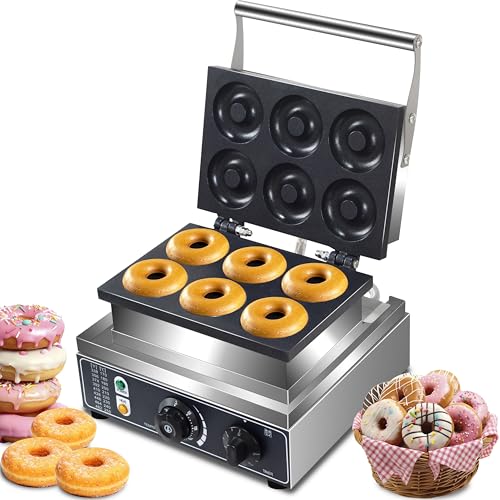
- 1600W dual-sided heating for even baking
- Adjustable 50–300°C temperature and 1–5 minute timer
- Compact stainless steel build with non-stick plates
Best For: Small commercial kitchens needing customizable baked doughnuts
Best Automated Size Flexibility
VEVOR Single-Row Automatic Donut Machine

- 3000W system with automated flipping and counting
- Three doughnut size ranges with adjustable thickness
- 5.5L hopper and 14.5L oil tank for extended production
Best For: Businesses needing automated frying and varied doughnut sizes
Best Lightweight Mini Option

- Bakes 23 mini doughnuts at once
- No flipping required and simple one-touch operation
- Lightweight design with non-stick plates
Best For: Low-volume service, events, bake sales, and mini-doughnut menus
Best High-Output Ring Doughnut Machine
VEVOR 4-Row Automatic Donut Maker

- Approximately 240 pieces per hour with four rows
- Automated flipping and intelligent controls
- 304 stainless steel body with 3L hopper and 6.1L oil tank
Best For: High-demand operations serving consistent 50 mm ring doughnuts
Best Batch-Controlled Pick
12-Hole Commercial Doughnut Maker
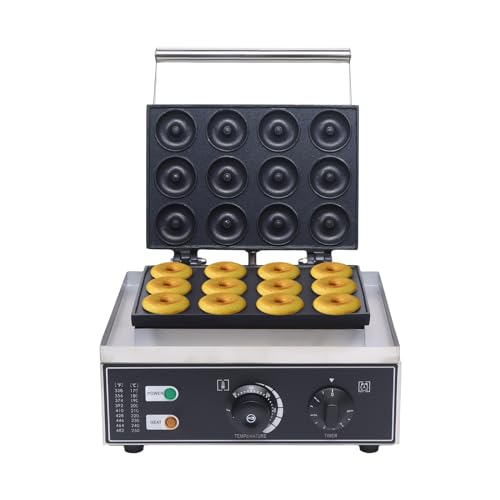
- 12-hole pan for batch production
- 1550W double-sided heating
- Independent time and temperature controls
Best For: Moderate-volume cafes, restaurants, and home-based doughnut businesses
Best Automatic Throughput
PYY Commercial Automatic Donut Maker

- Automatic forming, frying, flipping, and counting
- Up to 1,800 mini doughnuts per hour
- Five size adjustments and a 9L hopper
Best For: High-volume doughnut shops, cafes, and food trucks
Best Safety-Focused Production

- Automated four-row production
- Over 1,800 doughnuts per hour
- Overheating and double-switch protection
Best For: Commercial kitchens producing consistent mini doughnuts
Best Compact Batch Baker

- Makes 12 doughnuts per tray
- 1550W double-sided heating
- Independent time and temperature knobs
Best For: Small cafés and tea stores needing simple batch baking
Best Automated Starter

- Automates forming through output
- Up to 250 mini doughnuts per hour
- 304 stainless steel construction
Best For: Commercial shops wanting automated mini-doughnut production
Best High-Volume Option

- Six-row automated production
- Stated capacity up to 2,600 per hour
- 9L hopper with adjustable thickness
Best For: Busy commercial operations needing maximum listed throughput
Best Compact Commercial Pick – 6-Hole Commercial Donut Waffle Maker
For small businesses seeking doughnut makers for small businesses, this six-hole electric model offers a compact alternative to larger automated fryers. Its 1600W dual-sided heating, adjustable temperature, and timer support consistent baked doughnuts in cafés, bakeries, restaurants, and snack shops.
Best For: Small commercial kitchens that need compact, customizable baked doughnut production.
Pros:
- 1600W double-sided heating is designed for fast, even baking.
- Temperature adjusts from 50°C to 300°C, with a 1–5 minute timer.
- Non-stick plates support easier release and cleanup.
- Compact 33 × 32 × 23.5 cm design and 6.8 kg build provide stable operation.
Cons:
- Six-hole capacity may be limiting for very high-volume operations.
- It bakes doughnuts rather than providing automated frying and flipping.
This is a practical fit when counter space and recipe flexibility matter more than maximum throughput. The stainless steel construction and commercial-style controls add durability and consistency for regular business use.
Best Automated Size Flexibility – VEVOR Single-Row Automatic Donut Machine
This VEVOR model is one of the more production-focused doughnut makers for small businesses, combining automated flipping, counting, and adjustable sizing. Its 3000W power, 5.5L hopper, and 14.5L oil tank are suited to businesses that need a steady supply with less hands-on cooking.
Best For: Cafés, bakeries, and food stands that want automated frying and multiple doughnut sizes.
Pros:
- 3000W power is designed to increase production capacity.
- Automated operation includes flipping and counting for more consistent workflow.
- Supports mini, standard, and large doughnuts with adjustable thickness from 15 to 30 mm.
- 304 stainless steel construction is easy to clean and maintain.
Cons:
- At 61.7 pounds and 41.34 inches wide, it requires substantial workspace.
- Its oil-based frying setup involves more equipment and maintenance than a baked maker.
Choose this machine when labor reduction and size variety are priorities. Its larger footprint and frying configuration make it better suited to a dedicated production area than a small countertop station.
Best Lightweight Mini Option – 23-Hole Mini Donut Maker
For businesses testing a doughnut menu or serving occasional batches, this lightweight 23-hole appliance is a simple entry point among doughnut makers for small businesses. It heats quickly, requires no flipping, and uses non-stick plates for straightforward baking and cleanup.
Best For: Bake sales, cafés, events, and small businesses producing mini doughnuts in modest quantities.
Pros:
- Makes up to 23 mini doughnuts at once.
- One-touch operation and no-flip baking simplify training and use.
- Non-stick plates support easy release and cleaning.
- Lightweight 2.06 kg design is easy to move and store.
Cons:
- Its 110W power is intended for mini-doughnut batches rather than heavy commercial throughput.
- It offers a fixed mini-doughnut format instead of adjustable sizes.
This model makes sense for low-volume service, pop-ups, parties, and supplementary menu items. Its small footprint and simple operation are useful advantages, but higher-volume shops may outgrow its capacity.
Best High-Output Ring Doughnut Machine – VEVOR 4-Row Automatic Donut Maker
Businesses with stronger demand may prefer this four-row VEVOR machine over smaller doughnut makers for small businesses. It is rated for about 240 pieces per hour, uses automated flipping, and produces uniform 50 mm ring doughnuts with a 25 mm thickness.
Best For: Cafés, bakeries, and food stands that need high-output, consistent ring doughnuts.
Pros:
- Four rows and approximately 240 pieces per hour support high production.
- Intelligent controls and automated flipping reduce manual effort.
- Produces consistently sized 50 mm ring doughnuts with 25 mm thickness.
- 304 stainless steel construction includes a 3L hopper and 6.1L oil tank.
Cons:
- It makes a fixed ring-doughnut size rather than offering multiple mold options.
- Its 21.85 × 15 × 14.5 inch footprint needs dedicated counter or floor space.
- The 1750W frying system may require more operational planning than a small baked maker.
This is the strongest choice in the group for businesses prioritizing throughput and uniform ring doughnuts. Its automated workflow can support busy service, while the fixed format makes it less flexible for varied product menus.
Best Batch-Controlled Pick – 12-Hole Commercial Doughnut Maker
For small businesses seeking doughnut makers for small businesses, this 1550W countertop model offers a straightforward way to produce 12 doughnuts per batch. Its independently adjustable temperature and time controls make it practical for operators who want hands-on control over different recipes.
Best For: Cafes, restaurants, and home-based businesses that need batch production without a fully automatic frying system.
Pros:
- 12-hole pan supports multiple doughnuts per batch.
- Double-sided 1550W heating is designed for quicker, more even baking.
- Independent temperature and time knobs are approachable for beginners.
- Stainless steel and aluminum construction offers high thermal conductivity and durability.
Cons:
- It produces one tray at a time rather than automatically forming, frying, flipping, collecting, and counting doughnuts.
- Its 13.38-by-10.63-by-9.05-inch footprint still requires dedicated counter space.
This is a sensible choice when you value simple controls and baked doughnut consistency over maximum automated throughput. The 12-compartment design can improve productivity for moderate-volume orders.
Best Automatic Throughput – PYY Commercial Automatic Donut Maker
Among doughnut makers for small businesses, the PYY is aimed at operations that need automated production. It combines forming, frying, flipping, collecting, and counting, with adjustable settings and a stated output of up to 1,800 mini doughnuts per hour.
Best For: Doughnut shops, cafes, and food trucks handling bulk orders and looking to reduce manual production steps.
Pros:
- All-in-one automatic operation combines forming, frying, flipping, collecting, and counting.
- Four-row molds and a 9L hopper are designed for high-volume production.
- Five size adjustments accommodate mini doughnuts from 1.18 to 1.97 inches.
- Includes automatic temperature and timing control, a one-year warranty, and technical support.
Cons:
- Its commercial size and approximately 39.4-pound weight may be more machine than lower-volume sellers need.
- Automatic production equipment typically requires more setup and operating familiarity than a simple countertop baker.
The PYY stands out when labor efficiency and output matter most. Its anti-stick, anti-jam design and adjustable controls are useful for continuous production, while the stainless steel construction is suited to frequent commercial use.
Best Safety-Focused Production – HNZXIB 4-Row Mini Donut Maker
For small businesses comparing doughnut makers for small businesses, the HNZXIB combines automated four-row production with temperature, timer, and thickness controls. It is designed for commercial kitchens that need consistent mini doughnuts while keeping safety features and cleaning practicality in view.
Best For: Cafes, bakeries, hotels, and dessert shops producing 1.18- to 1.97-inch mini doughnuts in regular commercial batches.
Pros:
- All-in-one forming, frying, flipping, and counting supports automated production.
- Rated for more than 1,800 doughnuts per hour with a 5.5L hopper.
- Five thickness gears plus temperature and timer controls support repeatable results.
- 304 stainless steel, overheating protection, and double-switch start protection suit commercial use.
Cons:
- The listed 31-by-15.7-by-15.7-inch footprint requires substantial counter space.
- At about 40 pounds, it is not especially portable for frequently changing workstations.
- The supplied notes do not specify a conventional warranty duration.
This model is a strong fit for businesses prioritizing automated mini-doughnut production with added safety controls. Confirm the available workspace before buying, since its commercial capacity comes with a large footprint.
Best Compact Batch Baker – 12-Grid Electric Donut Maker
For small businesses comparing doughnut makers for small businesses, this 12-grid electric model offers a straightforward way to produce multiple doughnuts per tray without the complexity of an automatic fryer. Its 1550W heating system, nonstick coating, and independently adjustable time and temperature knobs suit cafés, tea stores, and party-service operations.
Best For: Cafés, tea stores, and small-batch businesses that want a compact electric doughnut maker with manual controls.
Pros:
- Produces up to 12 doughnuts at once with a double-sided baking tray.
- 1550W heating and double-sided constant-temperature baking support even cooking.
- Separate time and temperature knobs make operation approachable for beginners.
- Stainless steel and aluminum construction with a nonstick coating is practical for routine use.
Cons:
- It is a baking-style machine rather than a fully automatic forming and frying system.
- The listed 1–5 minute tray heating time may be slower than high-output automatic equipment.
- Its 19.8-pound build and countertop dimensions still require dedicated workspace.
This is a sensible entry point for businesses prioritizing simplicity, portion consistency, and moderate batch production. Choose a more automated model if your operation needs continuous forming, frying, counting, and output.
Best Automated Starter – FOHERE 4-Row Mini Donut Fryer
Among doughnut makers for small businesses, the FOHERE stands out for automating much of the production process in a relatively compact commercial format. It forms, drops, fries, flips, collects, counts, and outputs mini doughnuts, making it a practical fit for shops that need consistent service with less hands-on work.
Best For: Cafés, dessert shops, bakeries, and other commercial kitchens seeking automated mini-doughnut production.
Pros:
- Integrated forming, frying, flipping, collecting, counting, and output functions reduce manual handling.
- Four rows and a 3L hopper support output of up to 250 mini doughnuts per hour.
- 304 food-grade stainless steel construction is corrosion-resistant and easy to clean.
- Includes adjustable frying speed, constant temperature control, overheating protection, and start-safety switches.
Cons:
- It is designed for approximately 40 mm mini doughnuts rather than larger doughnut formats.
- The 21.85-by-14.76-by-14.57-inch footprint and roughly 35-pound weight need substantial counter space.
- The oil tank must contain oil before the machine is switched on.
The FOHERE offers a useful middle ground between manual equipment and larger production machinery. Its automated workflow can improve consistency, but operators must plan for oil handling, cleaning, and the machine’s fixed mini-doughnut format.
Best High-Volume Option – Kolice 6-Row Donut Machine
For businesses evaluating doughnut makers for small businesses with ambitious production targets, the Kolice six-row machine is built around continuous automated frying and conveying. Its 9L hopper, 17L oil tank, adjustable dough thickness, automatic counting, and stated capacity of up to 2,600 doughnuts per hour make it better suited to busy commercial locations than occasional batch service.
Best For: High-volume cafés, bakeries, dessert shops, canteens, and street-food operations with adequate floor and oil-handling space.
Pros:
- Six-row automated forming, frying, flipping, collecting, counting, and outputting support high throughput.
- Offers five thickness settings and doughnut sizes from approximately 1.18 to 1.97 inches.
- 304 stainless steel construction is durable, corrosion-resistant, and designed for easier cleaning.
- Includes temperature and timer controls, automatic overheating protection, and double-switch start protection.
Cons:
- Its 31.5-by-23.62-by-15.75-inch size is considerably larger than compact countertop makers.
- The machine’s stated temperature display is in Celsius, not Fahrenheit.
- It requires oil or water in the tank before operation and has a substantial 17L oil capacity.
The Kolice is the strongest choice here for throughput and adjustment flexibility, provided the business can accommodate its larger footprint and commercial oil workflow. Confirm that Celsius controls and the 110V, 60Hz specification suit your setup before buying.
How We Picked These Doughnut Makers for Small Businesses
We focused on the practical requirements of small commercial operations: productive capacity, heating performance, cooking consistency, ease of use, cleaning demands, and available workspace. The selection includes machines for different production levels, from compact 6- and 12-hole electric makers to automatic multi-row fryers designed for significantly higher throughput.
We also considered useful features such as non-stick cooking surfaces, adjustable temperature control, stainless-steel construction, multiple mould sizes, automatic feeding, hopper capacity, and straightforward controls. Published output figures are useful for comparison, but real production depends on dough type, portion size, operator workflow, and loading time.
Quick Comparison
| Machine type | Best suited to | Main advantage |
|---|---|---|
| Compact electric doughnut maker | Cafés, kiosks, and low-volume sellers | Small footprint and simpler operation |
| Multi-hole waffle-style maker | Made-to-order service | Direct control over cooking and batch size |
| Single-row automatic fryer | Growing takeaway businesses | More consistent production with less manual work |
| Four-row automatic fryer | Busy shops and event vendors | Higher throughput in a commercial format |
| Six-row high-capacity machine | Large-volume production | Maximum output when space and power allow |
Key Buying Factors for Doughnut Makers for Small Businesses
Capacity and Production Speed
Estimate your busiest realistic hour rather than relying only on an advertised hourly figure. Compact machines may be sufficient for made-to-order service, while automatic four- or six-row equipment is better for queues, wholesale orders, markets, and high-footfall locations. Avoid buying substantially more capacity than your staff, fryer area, and sales volume can support.
Machine Type and Workflow
Electric moulded makers are often simpler for cake-style or waffle-style doughnuts and may require less training. Automatic frying machines can improve consistency and reduce repetitive handling, but they need enough room for feeding, draining, cooling, and finishing the product.
Temperature Control and Consistency
Adjustable temperature control helps accommodate different batters, doughs, and recipes. Look for stable heating, clear controls, and even cooking across all cavities or rows. Consistent portioning is equally important because uneven doughnuts cook at different rates and increase waste.
Cleaning, Safety, and Installation
Check whether cooking surfaces, hoppers, trays, and oil-contact components can be removed or accessed easily. Confirm the required voltage, wattage, counter clearance, ventilation, and electrical capacity before purchase. For automatic fryers, plan for safe oil handling, drainage, filtration, and heat-resistant working space.
Who Should Buy Which Doughnut Makers for Small Businesses?
Choose a compact electric model if you operate a small café, stall, dessert counter, or test kitchen and expect modest batches. These machines are generally easier to place and operate.
Choose a 12-hole or similar commercial maker if you need faster made-to-order service while retaining hands-on control over recipes and finishing.
Choose a single-row automatic machine for a growing takeaway business that wants more repeatable output without moving immediately to the largest equipment.
Choose a four-row automatic fryer when demand is consistently high, labour efficiency matters, and you have sufficient space for oil management and product handling.
Choose a six-row high-capacity machine only when your sales volume, staffing, utilities, and preparation area justify it. For most small operators, matching capacity to actual demand is more valuable than choosing the fastest specification.