Making fermented vegetables at home does not require a large pantry or a full-size crock. The best fermentation crocks for small kitchens combine manageable capacities with dependable water seals, sturdy materials, and lids that are easy to clean and store.
This roundup compares compact glass and stoneware options ranging from pint-size vessels to one-gallon crocks, helping you choose the right balance of countertop footprint, batch size, airflow control, and everyday convenience.
Best 10 Fermentation Crocks for Small Kitchens Picks for 2026
Best Compact Plastic Crock

- 1.7-liter compact capacity
- Adjustable inner vacuum lid
- BPA-free and dishwasher safe
Best For: Small-batch kimchi, sauerkraut, and fresh-food storage
Best Traditional Stoneware Crock
2-Quart Bristol Pickling Crock

- Holds 2 quarts
- Lead-free food-safe glaze
- Dishwasher, microwave, and oven safe
Best For: Traditional vegetable fermentation and versatile kitchen storage
Best Water-Seal Glass Crock

- 1.5-liter thick glass jar
- Water-seal lid limits outside air
- Clear design for easy monitoring
Best For: Small-batch pickles, kimchi, and sauerkraut for two to three people
Best Tiny-Batch Crock
Blue 1-Pint Fermentation Crock

- Space-saving one-pint size
- USA-made stoneware
- Dishwasher, microwave, and oven safe
Best For: Very small ferments, pantry storage, and kitchen decor
Compact Water-Seal Classic
1.5L Ceramic Fermentation Crock

- 1.5-liter ceramic crock for smaller batches
- Water-seal lid supports an airtight environment
- Suitable for kimchi, sauerkraut, and pickles
Best For: Small households and limited kitchen space
Glass-Sleeved Modern Pick
Mortier Pilon 2L Glass Fermentation Crock

- Glass interior makes fermentation easy to monitor
- Includes sleeve, lid, weight, wax pencil, and booklet
- Moderate 2-liter capacity
Best For: Cooks who prioritize visibility and included accessories
See-Through Water-Seal Option

- Clear glass shows the fermentation process
- Water-seal lid helps limit outside air and dust
- 2.5-liter capacity for moderately large batches
Best For: Cooks who want visibility with a water-seal crock
Best Large-Batch Pick
1-Gallon Glazed Fermentation Crock

- 1-gallon stoneware capacity
- Water-seal lid with weights
- Includes pickle tamper
Best For: Larger sauerkraut, kimchi, pickle, vegetable, or kombucha batches
Best Compact Decorative Pick
0.6-Liter Blue Fermentation Crock
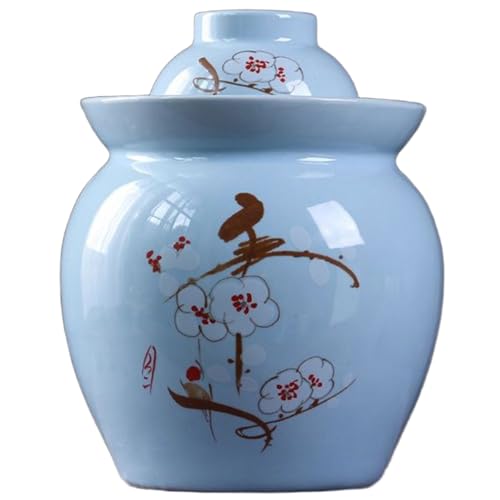
- Space-saving 0.6-liter size
- Waterlock seal for anaerobic fermenting
- Decorative blue geometric design
Best For: Small household batches and visible countertop storage
Best Mid-Size Balance
2-Liter Glazed Fermentation Crock

- Intermediate 2-liter capacity
- Water-seal lid and stone weights
- Glazed ceramic is easy to clean
Best For: Small households wanting more room than a mini crock
Best Compact Plastic Crock – Kimchi & Sauerkraut Container
For shoppers comparing fermentation crocks for small kitchens, this 0.4-gallon container offers a compact footprint and a lightweight plastic construction. Its adjustable inner vacuum lid is designed to reduce air inside during fermentation and storage.
Best For: Kimchi, sauerkraut, and fresh-food storage when counter and refrigerator space are limited.
Pros:
- Compact 6-by-4.5-by-7-inch design with 1.7-liter capacity
- Adjustable inner lid helps minimize air inside
- BPA-free, lead-free, dishwasher-safe polypropylene construction
- Clay-mixed material is designed for porosity and durability
Cons:
- Plastic construction may not suit shoppers seeking traditional stoneware or glass
- Its 0.4-gallon capacity is better for smaller batches than large ferments
This is a practical, easy-clean choice for frequent small-batch fermenting, especially when airtight storage and a compact shape matter more than a traditional crock aesthetic.
Best Traditional Stoneware Crock – 2-Quart Bristol Pickling Crock
Among fermentation crocks for small kitchens, this 2-quart Ohio Stoneware model balances a traditional stoneware format with a size suited to everyday countertop or pantry use. Its lead-free glaze is food safe and designed for straightforward cleanup.
Best For: Home fermenters who want a durable, multifunctional crock for vegetables, pantry storage, or kitchen use.
Pros:
- 2-quart capacity supports larger batches than pint-size crocks
- Lead-free, food-safe glaze
- Dishwasher, microwave, and conventional-oven safe
- Can also serve as a pantry or kitchen container
Cons:
- Stoneware is heavier than plastic or glass options at 3.2 pounds
- The 6-inch diameter and 6.25-inch height may require dedicated shelf space
Choose this crock if you prefer the feel of traditional stoneware and want one vessel that can support fermentation as well as general kitchen storage.
Best Water-Seal Glass Crock – 1.5-Liter Pickle Jar
This 1.5-liter glass jar is a useful option for fermentation crocks for small kitchens when visibility and a sealed setup are priorities. The water-seal lid is intended to limit outside dust and air, while the clear glass lets you monitor the contents.
Best For: Two- to three-person households making pickles, kimchi, sauerkraut, and other small batches.
Pros:
- 1.5-liter capacity suits small household batches
- Water-seal lid helps create an airtight fermentation environment
- Clear, thick food-grade glass makes contents visible
- Glass lid can also be used as a bowl
Cons:
- Hand wash only
- Water must be added to the lid seal weekly
- Glass may be less forgiving of impacts than plastic
The water-seal design offers a more traditional fermentation experience in a compact format, but it requires regular water checks and hand washing to maintain the setup.
Best Tiny-Batch Crock – Blue 1-Pint Fermentation Crock
For the tightest spaces, this one-pint Ohio Stoneware crock is one of the most compact fermentation crocks for small kitchens. Its 2.75-inch height and 3.5-inch diameter make it easy to display or tuck into a pantry, while the stoneware body is suitable for small-batch use.
Best For: Single-person batches, small tasting portions, decorative storage, and compact kitchen organization.
Pros:
- Small one-pint capacity fits limited counter and shelf space
- USA-made stoneware construction
- Dishwasher, microwave, and oven safe
- Won’t retain food flavors and can double as storage or decor
Cons:
- No lid is included
- One-pint capacity limits batch size
- Its small opening and dimensions may be less practical for larger vegetables
This is a charming choice for experimenting with very small quantities or adding a dedicated utility crock to a compact kitchen, but the lack of a lid may require a separate covering solution.
Compact Water-Seal Classic – 1.5L Ceramic Fermentation Crock
For shoppers comparing fermentation crocks for small kitchens, this 1.5-liter ceramic jar offers a relatively compact format with a traditional water-seal lid. It is designed for homemade kimchi, sauerkraut, pickles, vegetables, jams, sauces, and other preserved foods.
Best For: Small households and cooks who want a durable ceramic crock for batches serving roughly two to five people.
Pros:
- Water-seal design helps create an airtight fermentation environment.
- Thick ceramic construction is intended for repeated use.
- Suitable for kimchi, sauerkraut, pickles, vegetables, sauces, jams, and more.
- Curved light-yellow design can also serve as kitchen decor.
Cons:
- The 1.5-liter capacity may be limiting for larger batches.
- The water channel needs replenishing weekly to maintain the seal.
- Ceramic construction prevents viewing the fermentation process directly.
This is a practical choice when you want a compact, reusable ceramic crock and do not mind monitoring the water seal. Its smaller capacity makes it particularly suitable for limited counter or storage space.
Glass-Sleeved Modern Pick – Mortier Pilon 2L Glass Fermentation Crock
Among fermentation crocks for small kitchens, the Mortier Pilon 2L stands out with a glass interior and silicone sleeve. Its modern design combines a visible fermentation vessel with included accessories intended to make setup and recipe-following straightforward.
Best For: Cooks who want a 2-liter crock with a glass interior, protective sleeve, and starter guidance.
Pros:
- 100% glass interior lets you see the contents during fermentation.
- Silicone sleeve provides an outer layer around the glass jar.
- Includes a lid, elastic band, veggie-pattern ceramic weight, wax pencil, and instruction and recipe booklet.
- 2-liter capacity suits moderate home batches.
Cons:
- The listed dimensions may require more shelf or counter space than a compact jar.
- Glass may require more careful handling than a thick ceramic crock.
- The supplied notes do not specify a water-seal lid.
This model is appealing if visibility and included accessories matter more to you than a traditional ceramic water-seal design. The recipe booklet and wax pencil are useful extras for cooks getting started with fermentation.
See-Through Water-Seal Option – 2.5L Glass Fermentation Jar
For fermentation crocks for small kitchens, this 2.5-liter glass jar offers a useful balance of batch capacity and visibility. The water-seal lid is designed to help keep outside dust and unwanted smells out while allowing you to watch the fermentation process.
Best For: Households wanting a larger glass crock for kimchi, sauerkraut, pickles, vegetables, and other preserved foods.
Pros:
- Clear glass lets you observe the fermentation process directly.
- Water-seal lid supports an airtight environment.
- 2.5-liter capacity accommodates larger batches than the 1.5-liter option.
- Lead-free material specifications and a two-year warranty are listed.
Cons:
- Hand-wash-only care may take more effort.
- The water channel should be refilled weekly to maintain the seal.
- The larger capacity may occupy more space in a small kitchen.
This jar is a strong fit for cooks who want to monitor progress without opening the vessel. Choose it when the 2.5-liter capacity suits your batch sizes and you have room for hand washing and storage.
Best Large-Batch Pick – 1-Gallon Glazed Fermentation Crock
For fermentation crocks for small kitchens, this 3.8-liter stoneware model offers substantial capacity without moving into the largest crock sizes. Its water-seal lid, weights, and pickle tamper make it a practical all-in-one option for sauerkraut, kimchi, pickles, vegetables, or kombucha.
Best For: Small kitchens that need a versatile crock for larger household batches, including approximately four mason jars of sauerkraut.
Pros:
- 1-gallon capacity suits roughly 2–5 cabbages and larger fermentation batches.
- Water-seal design lets gases escape while helping keep outside air out.
- Includes stone weights, lid, and pickle tamper.
- Glazed, food-grade ceramic is described as non-porous, lead- and cadmium-free, and easy to wash.
Cons:
- At 7.39 pounds before filling, it may be cumbersome in a compact kitchen.
- Its larger capacity may be more than needed for occasional small batches.
This is a strong capacity-to-footprint choice when you want one dedicated vessel for several types of fermentation. The included accessories and water seal reduce the need to buy additional equipment, although storage space and filled weight are worth considering.
Best Compact Decorative Pick – 0.6-Liter Blue Fermentation Crock
If counter and cabinet space are priorities, this 0.6-liter stoneware crock is one of the more compact fermentation crocks for small kitchens. It is designed for smaller servings of sauerkraut, kimchi, pickles, and vegetables, while its blue Chinoiserie-inspired pattern gives it a decorative presence.
Best For: Solo cooks or small households making modest batches and wanting a crock that can remain visible as kitchen decor.
Pros:
- 0.6-liter size is suited to limited counter and storage space.
- Waterlock seal creates an oxygen-free environment while allowing gases to escape.
- Wide waterlock is designed to reduce the need for frequent seal refilling.
- Stoneware construction and a decorative blue geometric design combine function with display appeal.
Cons:
- Its small capacity is less suitable for family-sized or large vegetable batches.
- The supplied notes do not list included fermentation weights or a tamper.
This is the most space-conscious option in the group and a good fit when you prefer frequent, small-batch fermentation. Its decorative styling may also make it easier to justify keeping the crock on a shelf or counter.
Best Mid-Size Balance – 2-Liter Glazed Fermentation Crock
This 2-liter stoneware crock balances batch size and storage needs, making it a practical middle ground among fermentation crocks for small kitchens. It is intended for kimchi, sauerkraut, pickles, vegetables, and kombucha, with a water-seal lid and stone weights included.
Best For: Small households that want more capacity than a mini crock without stepping up to a full 1-gallon vessel.
Pros:
- 2-liter capacity offers a useful compromise between compact storage and batch volume.
- Water-seal lid allows gases to escape while helping prevent outside air from entering.
- Includes stone weights and a lid for a ready-to-use setup.
- Glazed ceramic is described as non-porous, food-grade, lead- and cadmium-free, and easy to clean.
Cons:
- At 5.48 pounds empty, it is still a substantial ceramic item for a small kitchen.
- The supplied description contains conflicting capacity references, so shoppers should verify the listed size before ordering.
For shoppers who find a 0.6-liter crock too restrictive but a 1-gallon model too bulky, this version is the logical compromise. Verify the capacity details before purchase, then factor in the included weights and water-seal design when comparing total value.
How We Picked the Best Fermentation Crocks for Small Kitchens
We selected these 10 vessels for their suitability in kitchens where counter and cabinet space are limited. Our comparison considers capacity, material, sealing design, cleaning requirements, portability, and the kinds of foods each crock can handle. The list includes small stoneware crocks, glass jars with water-seal lids, and mid-size models for users who want to make larger batches without committing to a bulky traditional fermenting pot.
Because product specifications can vary by seller, confirm the listed capacity, included weights, airlock or water-seal components, and dishwasher guidance before ordering.
Quick Comparison
| Best For | Recommended Capacity | Material | What to Look For |
|---|---|---|---|
| Occasional small batches | 1 pint to 1.5 liters | Glass or ceramic | Compact footprint and easy monitoring |
| Regular kimchi or sauerkraut | 1.5 to 2 liters | Glass or stoneware | Water seal, weights, and secure lid |
| Family-size batches | 2.5 liters to 1 gallon | Stoneware | Stable base and ample headspace |
Key Buying Factors for Fermentation Crocks for Small Kitchens
Capacity and Counter Space
Choose the smallest vessel that fits your normal batch size. Pint and 1.5-liter models are easier to store, while 2-liter crocks offer a useful middle ground for regular batches. A 2.5-liter or one-gallon crock is better for frequent meal prep but needs more storage space and may be heavier when full.
Water Seals and Air Control
A water-seal lid helps release fermentation gases while limiting outside air, dust, and contaminants. Glass jars make it easier to observe bubbling and fill levels, while traditional stoneware often provides a more stable, light-blocking environment. Check whether the seal needs to be filled or maintained during longer ferments.
Material, Cleaning, and Handling
Glazed stoneware is durable and typically resists staining, but it can be heavy and should be inspected for chips or cracks. Glass is easy to monitor and generally lighter, though it needs careful handling. Look for wide openings, removable lids, and included weights that can be washed thoroughly after each batch.
Weights and Usability
Vegetables should remain below the brine. If weights are not included, budget for food-safe fermentation weights that fit the opening. Also consider whether the lid, gasket, crock, and accessories can be stored together in a small cabinet.
Who Should Buy Which Fermentation Crocks for Small Kitchens?
Choose a pint-size ceramic crock if you want the smallest option for testing recipes, making condiments, or fermenting occasional vegetables. A 1.5-liter glass jar is a practical choice for beginners who want to watch the process and keep storage simple.
For regular kimchi, sauerkraut, or pickle batches, a 2-liter water-sealed crock offers a balanced combination of capacity and countertop efficiency. Select a 2.5-liter model if you prepare larger batches but still want a relatively compact vessel. A 3.8-liter or one-gallon stoneware crock makes the most sense for households that ferment often, share batches, or want extra headspace—provided you have a stable storage location.