Choosing among pH meters for food storage can be difficult because food samples are thicker, softer, and less uniform than ordinary liquids. A suitable tester needs a food-safe probe, dependable calibration, and a design that works with the foods you actually prepare.
This roundup compares 10 options for fermentation, canning, sourdough, meat, cheese, and other food applications, with practical guidance to help you select the right balance of accuracy, convenience, and maintenance.
Best 10 Ph Meters for Food Storage Picks for 2026
Premium Food Testing

- Food-grade replaceable spear sensor
- ±0.01 accuracy with auto calibration and ATC
- Complete kit with solutions and carrying case
Best For: Testing cheese, dairy, sauces, fruit, and other semi-solid foods
Fermentation and Canning Value
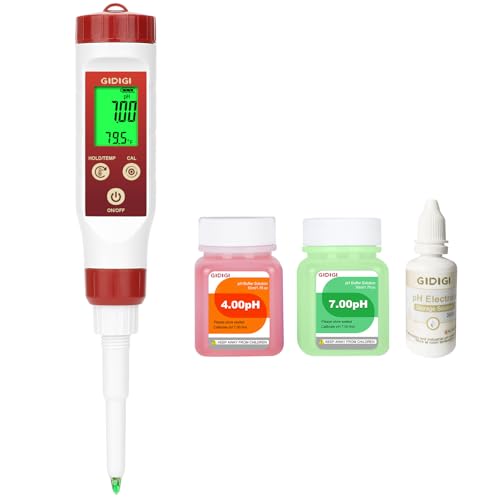
- Includes calibration and electrode-protection solutions
- Spear probe handles semi-solid food samples
- Water-resistant body with detachable probe
Best For: Fermentation, canning, sauces, dairy, and home brewing
Connected Data Tracking
Apera AI3713 Smart Spear pH Tester

- Food-grade spear probe for solid samples
- Cloud records can include notes, photos, and GPS
- Works as a standalone or smartphone-connected tester
Best For: Documented food testing and shareable measurement records
Complete Fermentation Kit
GIDIGI Spear pH Meter for Food

- ±0.01 reading with ATC and temperature display
- Includes three buffer solutions for calibration
- Replaceable spear probe for dough, meat, and cheese
Best For: Fermentation, canning, cheese making, brewing, and sourdough
Smart Fermentation Pick

- Bluetooth app tracks pH, temperature, and fermentation data
- ±0.05 accuracy with fast readings and ATC
- Rechargeable, IP65-rated, and supplied with calibration powders
Best For: Data-focused fermentation and food testing at home or on the go
Spear-Probe Fermentation Pick

- Directly tests semi-solid and liquid foods without slurry preparation
- 0.00–14.00 range with ±0.1 accuracy and ATC
- Includes three-point calibration and six buffer packets
Best For: Sourdough, sauces, cheese, and other direct-probe food testing
Canning-Focused Pick

- Designed for canning, fermentation, and food acidity monitoring
- Spear probe handles solids, semi-solids, liquids, and emulsions
- Backlit color display, ATC, and three calibration solutions included
Best For: Food preservation and fermentation with thicker samples
Best for Versatile Fermentation

- Tests solid, semi-solid, and liquid samples
- ATC supports stable temperature-adjusted readings
- KCL-soaked cap helps protect the probe
Best For: Sourdough, sauces, canning, and beverage testing
Best for Multi-Purpose Home Testing
Food pH Meter for Dough and Liquids

- Measures dough, liquids, and semi-solid foods
- Suitable for kombucha and home brewing
- Includes two LR44 batteries
Best For: Broad household food, beverage, and soapmaking use
Best Calibration Kit Included

- Includes pH 4.00 and 7.00 solutions
- Automatic calibration simplifies setup
- Conical electrode is designed for dough
Best For: Sourdough and fermentation users wanting calibration supplies included
Premium Food Testing – Apera PH60S Food pH Meter Kit
For shoppers comparing ph meters for food storage, the Apera PH60S is a purpose-built option for checking solid and semi-solid foods. Its food-grade Swiss spear electrode, automatic calibration, and temperature compensation make it practical for kitchen and food-preparation testing.
Best For: Cheese, sushi rice, fruit, dairy, sauces, and other solid or semi-solid foods.
Pros:
- Food-grade, replaceable Swiss spear sensor
- ±0.01 pH accuracy with a -2.00 to 16.00 range
- Auto calibration, ATC, and high/low value alarms
- Includes calibration solutions, storage solution, batteries, and carrying case
Cons:
- The feature-rich kit may be more than casual users need
- Requires proper electrode storage and calibration maintenance
The PH60S stands out when you want a complete, food-focused kit with clear status indicators and a replaceable probe. Its carrying case also helps keep the accessories organized between tests.
Fermentation and Canning Value – GIDIGI Digital Food pH Meter
Among ph meters for food storage, this GIDIGI model is aimed at fermentation and canning tasks. The spear-shaped probe is designed for semi-solid samples, while the included calibration and electrode-protection solutions help you begin testing right away.
Best For: Home fermentation, canned foods, sourdough, dairy, sauces, kombucha, and brewing applications.
Pros:
- Includes pH 4.00 and 7.00 calibration solutions plus protection solution
- Spear probe penetrates cheese, meat, bread, and other semi-solid foods
- Water-resistant design suits wet kitchen environments
- Detachable probe supports longer service life
Cons:
- Alkaline-food testing requires a separately sourced pH 10.01 solution
- The supplied notes do not specify a stated accuracy figure
This is a practical choice for users who want one tester for several kitchen projects, especially canning and fermentation. Its water-resistant body and detachable probe add convenience for regular use.
Connected Data Tracking – Apera AI3713 Smart Spear pH Tester
APERA INSTRUMENTS AI3713 PH60S-Z Smart Spear pH Tester for Food and Solid Sampling pH Measurement'
Check Price On AmazonFor buyers seeking ph meters for food storage with digital recordkeeping, the Apera AI3713 adds cloud-based data management to a food-grade spear tester. It can operate as a standalone meter, or connect with a smartphone for saved measurements and additional testing notes.
Best For: Users who need to record, organize, share, and document food pH measurements.
Pros:
- Food-grade Swiss spear probe for direct solid sampling
- Cloud-based data management helps preserve and share records
- Supports GPS location, notes, and photos with saved data
- Hybrid design works with or without a smartphone
Cons:
- Smartphone-connected features may be unnecessary for simple spot checks
- The listed weight is higher than the other pen-style options here
The AI3713 is especially useful when traceability matters. Its combination of direct food sampling and richer measurement records makes it a strong fit for organized testing workflows rather than occasional household checks.
Complete Fermentation Kit – GIDIGI Spear pH Meter for Food
This GIDIGI meter is a versatile pick among ph meters for food storage, fermentation, and canning. Its replaceable spear electrode is made for dough, meat, cheese, and other semi-solid foods, while automatic temperature compensation and included three-point buffers support repeatable testing.
Best For: Fermentation, canning salsa, sourdough, cheese making, curing meats, brewing, and beverage testing.
Pros:
- Stated ±0.01 pH reading with automatic temperature compensation
- Replaceable spear electrode delivers fast readings in semi-solid foods
- Includes pH 4.00, 7.00, and 10.01 buffer solutions
- Waterproof body, backlit display, carrying case, and temperature display
Cons:
- The broader feature set may be excessive for occasional testing
- Probe replacement and calibration supplies will eventually add maintenance costs
With buffers for acidic and alkaline testing, this model is well suited to users working across multiple recipes and formulations. The replaceable probe can also make it a more sustainable long-term option than a disposable tester.
Smart Fermentation Pick – App-Connected Food pH Meter
For shoppers comparing ph meters for food storage and fermentation, this smart LKBIRD model stands out for Bluetooth monitoring, app alerts, and temperature tracking. Its stated ±0.05 pH accuracy, 3–5 second stable readings, ATC, and rechargeable battery make it suited to repeat testing at home or on the go.
Best For: Fermentation projects where tracking, exporting, and reviewing pH data is especially useful.
Pros:
- Connects to a smartphone for real-time pH and temperature monitoring, data storage, and custom alerts.
- Offers ±0.05 pH accuracy, fast stable readings, and automatic temperature compensation.
- Rechargeable Type-C battery, backlit display, included calibration powders, and IP65 waterproof protection support convenient routine use.
Cons:
- App connectivity adds setup and dependence on a smartphone for its smart features.
- The supplied notes do not specify the exact operating runtime per charge.
This is the most feature-rich option of the three, particularly for users who want a digital record of fermentation results rather than occasional spot checks.
Spear-Probe Fermentation Pick – YINMIK Food pH Meter
Among ph meters for food storage, the YINMIK is designed for direct testing of thick or semi-solid samples. Its proprietary spear probe can be inserted into sourdough, sausages, cheese, sauces, jam, and other foods without first making a slurry, while ATC and a 0.00–14.00 range support varied testing.
Best For: Home fermenters and cooks who need direct pH checks in dough, sauces, dairy, and other semi-solid foods.
Pros:
- Spear probe is designed for direct measurements in semi-solid and liquid samples.
- Provides a 0.00–14.00 pH range, ±0.1 accuracy, ATC, and enhanced chip stability.
- Three-point auto-calibration and six included buffer-powder packets simplify setup and maintenance.
Cons:
- It does not include the app-based monitoring and data-export features of the smart model.
- The supplied notes do not identify a rechargeable battery or waterproof rating.
The probe design and wet-storage sponge are practical touches for frequent food and fermentation testing, especially when working with samples that are difficult to liquefy.
Canning-Focused Pick – GIDIGI Spear Probe pH Meter
For ph meters for food storage, the GIDIGI model is particularly oriented toward canning and acidity monitoring. Its spear-tip probe handles solids, semi-solids, and liquids, while the 0–14 range, ATC, color display, and included calibration solutions make it a versatile kitchen testing tool.
Best For: Canning, food preservation, and fermentation users who want a clear display and a probe for thicker foods.
Pros:
- Spear probe is intended for sauces, dairy, meat, emulsions, and other challenging samples.
- ATC and a separate temperature sensor help limit reading fluctuations.
- Includes calibration solutions at pH 4.00, 7.00, and 10.01, plus a vivid backlit color display.
Cons:
- It uses AAA batteries rather than a rechargeable battery.
- At 1.17 pounds, it is heavier than the other listed meters.
- The stated ± accuracy value is not provided in the supplied notes.
This is a practical choice for users prioritizing direct acidity checks during canning and preservation, with a display and probe designed for everyday kitchen use.
Best for Versatile Fermentation – Spear-Probe Food pH Meter
If you need ph meters for food storage and preparation, this model is designed for checking both solid foods and liquids. Its spear-tip probe reaches into dough and other semi-solid samples, while the 0–14 pH range supports common fermentation, canning, and beverage-testing tasks.
Best For: Home bakers and fermenters testing sourdough, sauces, canned foods, kombucha, milk, and other food or beverage samples.
Pros:
- Spear probe is designed for solid, semi-solid, and liquid samples.
- ATC helps provide consistent readings across changing temperatures.
- Protective cap includes a KCL-soaked sponge to help keep the probe moist.
- Large LCD display is easy to read during testing.
Cons:
- The notes do not specify included calibration solutions.
- Its 1.04-pound package weight may be more than needed for occasional testing.
This is a flexible choice for users who want one meter for sourdough, fermented sauces, canned foods, and liquids. The spear sensor and probe-moistening cap are particularly useful for recurring fermentation work.
Best for Multi-Purpose Home Testing – Food pH Meter for Dough and Liquids
Among ph meters for food storage, this digital tester stands out for covering food, beverage, and some cosmetic applications. The spear probe is made for inserting into sourdough and other semi-solid foods, while its liquid-testing capability suits kombucha, water, beverages, and home brewing.
Best For: Home users checking sourdough, kombucha, sushi rice, salami, pickles, jams, cheese, soap, and other liquid or semi-solid mixtures.
Pros:
- Spear probe delivers quick readings in dough and other semi-solid samples.
- Supports testing for kombucha, beer, vinegar, water kefir, and beverages.
- Useful for a broad range of foods, including sushi rice, salami, jams, cheese, and pickles.
- Includes two LR44 batteries.
Cons:
- The notes do not mention included calibration solutions.
- The product’s wide application range may be unnecessary for buyers focused only on food storage.
This model makes sense when versatility matters more than a narrow food-only design. It can cover everyday fermentation checks as well as food preparation and soapmaking, with a probe suited to direct sampling.
Best Calibration Kit Included – YINMIK Food pH Tester
For shoppers comparing ph meters for food storage, the YINMIK is convenient because it includes pH 4.00 and 7.00 calibration solutions. Its conical-tip electrode is intended for bread and dough, while the 0–14 range supports fermentation and acidity checks across many stored or prepared foods.
Best For: Users who want an included calibration kit for sourdough and fermented foods such as sausages, salami, cheese, sushi rice, jams, sauces, and salsa.
Pros:
- Includes 4.00 and 7.00 calibration solutions.
- One-click automatic calibration is designed to simplify setup.
- ATC and a KCL-moistened protective cap support stable readings and probe care.
- Conical-tip electrode is designed for bread and dough.
Cons:
- Calibration requires regular attention for accurate results.
- Uses three LR44 batteries, rather than the two listed for some comparable models.
The included calibration fluids make this the most convenient option of the three for buyers starting from scratch. It is especially well matched to sourdough and fermentation projects where regular calibration and probe maintenance are important.
How We Picked the Best Ph Meters for Food Storage
We focused on models designed or marketed for direct food testing rather than basic aquarium or hydroponic meters. Our comparison considers probe shape, stated accuracy, calibration features, automatic temperature compensation, display readability, power options, and suitability for solid or semi-solid samples.
We also looked for useful maintenance accessories, including calibration solutions and storage caps. These details matter because pH performance depends heavily on proper cleaning, calibration, and probe storage—not just the number printed on the package.
Quick Comparison
| Best For | Look For | Why It Matters |
|---|---|---|
| Fermentation and canning | Food-grade spear probe and calibration solution | Improves contact with thick foods and supports repeatable checks |
| Sourdough and dough | Probe suited to semi-solid samples | Reduces unreliable readings caused by poor sample contact |
| Frequent testing | Rechargeable battery and replaceable or durable electrode | Reduces interruptions and long-term operating costs |
| Mixed food types | Wide pH range and ATC | Provides more flexibility across recipes and temperatures |
Key Buying Factors for Ph Meters for Food Storage
Probe Design and Food Compatibility
A spear-style food probe is generally more practical for dense foods such as meat, cheese, dough, salsa, and fermented vegetables. Check whether the electrode is described as food-grade and whether it can be inserted safely without excessive pressure.
Accuracy, Calibration, and Temperature Compensation
Pay attention to the stated accuracy, resolution, and calibration process. Two- or three-point calibration can provide better coverage across different readings. Automatic temperature compensation, often labeled ATC, helps reduce temperature-related variation, but it does not replace proper calibration.
Cleaning and Storage
Food residue can contaminate the probe and distort later readings. Choose a meter with clear cleaning instructions, a protective cap, and storage solution when possible. Never store a glass electrode dry unless the manufacturer specifically permits it.
Ease of Use
Large displays, stable-reading indicators, simple calibration buttons, rechargeable power, and app connectivity can make routine testing easier. These conveniences are useful, but they should not outweigh probe quality and maintenance support.
Who Should Buy Which Ph Meters for Food Storage?
Home fermenters and canners: Choose a dedicated food meter with a spear probe, calibration solution, and a clear display. These features support repeated checks of salsa, pickles, sauces, and other preparations.
Sourdough bakers: Look for a probe designed for dough or semi-solid foods and a compact shape that is easy to clean after use.
Frequent or advanced users: A more durable electrode, ATC, rechargeable operation, wider measurement range, or smart-app features may justify a higher price.
Occasional users: A straightforward digital tester can be sufficient if it includes calibration supplies and you are willing to follow the cleaning and storage instructions carefully.
For food safety decisions, use reliable recipes and tested preservation guidance alongside a meter. A pH reading is a useful measurement tool, but it does not replace safe processing methods, accurate temperatures, or proper ingredient handling.