Choosing among fruit presses for small businesses means balancing batch capacity, pressing force, food-contact materials, cleanup, and available workspace. The right press can improve juice yield while making repetitive production more manageable.
This roundup compares 10 manual and hydraulic options for cider makers, farm stands, juice vendors, wineries, and other small-scale producers. Use the guide below to match press style and capacity to your typical workload.
Best 10 Fruit Presses for Small Businesses Picks for 2026
Best High-Capacity Hydraulic Pick
40L Mosakar Hydraulic Fruit Press

- 40L capacity and 5-ton hydraulic pressure
- AISI 304 stainless juice-contact parts
- Adjustable tray and rotating beam
Best For: Large-batch orchard, cider, and harvest processing
Best Citrus Countertop Option
Commercial Cast Iron Citrus Press

- Food-grade stainless steel and cast iron construction
- Dishwasher-safe removable strainer and funnel
- Compact design for counters and cabinets
Best For: Citrus-focused juice stands, bars, and restaurants
Best Mid-Size Hydraulic Value
30L Mosakar Hydraulic Fruit Press

- 30L capacity for medium-sized batches
- 3-ton hydraulic pressing force
- Stainless juice-contact parts and powder-coated frame
Best For: Small cider, wine, and orchard operations
Best Manual Wood Press

- 18L capacity with beechwood basket
- Progressive screw press and extended handle
- Includes two food-grade filter bags
Best For: Small wineries, farms, shops, and moderate batches
Best for Easy Setup
5.8-Gallon Stainless Steel Fruit Press

- 6,613.87-pound hydraulic pressing force
- 5.81-gallon outer barrel with 2.91-gallon filter barrel
- 304 stainless steel frame with reinforced brackets
Best For: Small commercial or home-based cider, wine, and juice production
Complete Filtering Workhorse
Hydraulic Apple and Cider Press
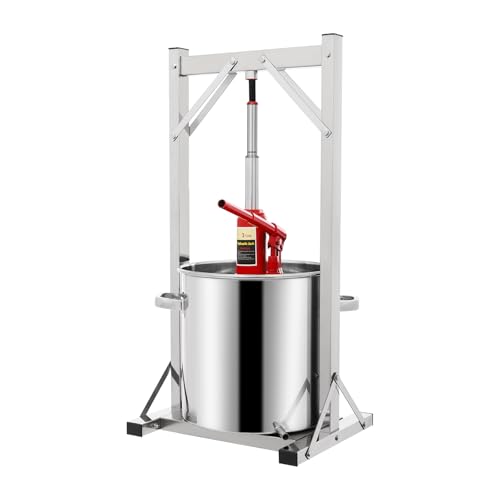
- Hydraulic force reaches 6,613.87 pounds
- Includes outer and filter buckets plus jack
- 5.81-gallon capacity with stainless steel construction
Best For: Apple juice, cider, and filtered fruit-wine production
Compact Manual Option
2.38-Gallon T-Handle Fruit Press

- 2.38-gallon stainless steel capacity
- Heavy-duty T-handle and cross-beam design
- Suitable for apples, grapes, berries, cider, and wine
Best For: Small-batch producers and home brewers using manual pressing
Traditional Wooden Workhorse
SQUEEZE master 12L Fruit Press

- 3.17-gallon capacity for about 12–16 lb of fruit
- Longer hand shank helps reduce pressing effort
- Includes a filter bag for fruit, wine, and cider use
Best For: Small fruit stores, eateries, and seasonal pressing
High-Capacity Hydraulic Performer
VEVOR 30L Hydraulic Fruit Press

- 7.93-gallon stainless-steel pressing capacity
- Jack-style hydraulic design with strong pressing force
- Removable bucket and two filter bags aid cleanup and use
Best For: Orchards, farms, wineries, and larger small-business batches
Compact Beechwood Starter

- Compact size for modest batches and limited spaces
- Beechwood basket with breakaway pulp removal design
- Pour spout and optional foot mounting support stable collection
Best For: Home-based sellers, small juice shops, and seasonal use
Best High-Capacity Hydraulic Pick – 40L Mosakar Hydraulic Fruit Press
For small businesses processing substantial batches, this 40L Mosakar is one of the more capable fruit presses for small businesses. Its hydraulic jack applies 5 tons of pressure, while juice-contact components use AISI 304 stainless steel for durability and easier cleanup.
Best For: Orchards, harvest-season processing, cider makers, and small operations handling large batches.
Pros:
- Large 10.6-gallon/40L capacity with 5 tons of hydraulic pressure.
- AISI 304 stainless-steel basket, pressing plate, and juice tray resist acidic juice.
- Adjustable tray height and a 90-degree-turning beam support easier loading and container placement.
- Suitable for fruit, herbs, nut milks, and honey.
Cons:
- At 85 pounds, it is relatively heavy to move.
- The larger frame requires more storage space than a countertop citrus press.
This is a strong choice when batch capacity and pressing force matter more than portability. The stainless juice path and adjustable setup add practical value for repeated seasonal use.
Best Citrus Countertop Option – Commercial Cast Iron Citrus Press
Businesses focused on citrus drinks may prefer this compact manual press over a large basket-style machine. It combines a solid cast-iron frame with 304 food-grade stainless steel, a removable dishwasher-safe strainer and funnel, and a lever designed for quick extraction.
Best For: Juice stands, bars, restaurants, grocery counters, and small businesses serving citrus beverages.
Pros:
- Works with oranges, lemons, limes, grapefruit, pomegranates, and other listed fruits.
- Removable strainer and funnel are dishwasher safe.
- Rubber feet help prevent slipping and protect countertops.
- Compact 8.5-by-6.7-by-15.5-inch design fits under many cabinets.
Cons:
- Its citrus-squeezer design is less suited to large apples, grapes, or batch pressing.
- Manual operation requires repeated lever use during busy service.
Choose this model when speed, footprint, and citrus versatility are more important than large-batch capacity. It arrives fully assembled, making it convenient for immediate counter service.
Best Mid-Size Hydraulic Value – 30L Mosakar Hydraulic Fruit Press
This 30L Mosakar offers a practical middle ground for fruit presses for small businesses that need meaningful capacity without moving up to the largest model. Its 3-ton hydraulic system is paired with stainless-steel juice-contact parts and a powder-coated frame.
Best For: Small cider, wine, and orchard operations needing a durable mid-size batch press.
Pros:
- 7.93-gallon/30L capacity supports substantial batches.
- 3 tons of pressure provide strong juice extraction.
- Juice tray, basket, and pressing plate are made from AISI 304 stainless steel.
- Powder-coated frame and solid construction are designed for long-term use.
Cons:
- It is still a substantial 66-pound machine.
- Its capacity and frame are less portable than smaller manual presses.
For operators who want hydraulic assistance and a commercial-feeling build without the 40L model’s extra size, this is a sensible compromise. Stainless contact parts also simplify routine hygiene and maintenance.
Best Manual Wood Press – VEVOR 18L Fruit Wine Press
For smaller producers seeking a manual option, this VEVOR wood press offers an 18L capacity with a beechwood basket, progressive screw mechanism, and filter bags. It suits fruit wine and juice work where a lower-tech setup and lighter 30.9-pound body are useful.
Best For: Small wineries, farms, restaurants, fresh juice shops, and occasional batch processing.
Pros:
- 4.75-gallon/18L capacity is suitable for smaller batches and gatherings.
- Extended handle and spiral mechanism support manual pressing with less effort.
- Includes two food-grade filter bags and eight supporting blocks.
- Can be used for juice, fruit wine, pulp, cheese, and olive oil.
Cons:
- Hard fruits must be crushed before pressing.
- Wood construction requires hand washing rather than dishwasher cleaning.
- Manual operation is slower and more labor-intensive than hydraulic pressing.
This press is a good fit where batch sizes are moderate and a simple manual workflow is acceptable. Its wood basket and included filtration accessories make it versatile, but preparation and cleanup require more hands-on work.
Best for Easy Setup – 5.8-Gallon Stainless Steel Fruit Press
For small businesses seeking fruit presses for small businesses, this stainless steel hydraulic model emphasizes capacity, stability, and reduced manual effort. Its 5.81-gallon outer barrel and 2.91-gallon filter barrel suit cider, wine, and juice production in larger batches.
Best For: Small commercial or home-based producers who want hydraulic assistance for cider, wine, and mixed-fruit processing.
Pros:
- Food-grade 304 stainless steel is rust-proof, hygienic, and polished for easier cleaning.
- Hydraulic jack provides up to 6,613.87 pounds of pressure to reduce manual effort.
- Reinforced triangular brackets support loads up to 330.69 pounds.
- Large outer and filter barrels improve batch productivity.
Cons:
- Its larger capacity may be more than needed for very small batches.
- The supplied notes do not specify the unit’s dimensions or total weight.
This is a practical choice when throughput and pressing power matter more than compactness. The stainless steel construction and reinforced frame make it well suited to repeat processing, while the hydraulic jack helps limit operator fatigue.
Complete Filtering Workhorse – Hydraulic Apple and Cider Press
Fruit Press Crusher Grinder Apple Juice Wine Cider & Hydraulic Jack Fruit Press
Check Price On AmazonAmong fruit presses for small businesses, this model stands out for including a filter bucket and compatibility with a filter cloth. The 5.81-gallon capacity and hydraulic jack are designed for efficient apple juice, cider, and fruit-wine production.
Best For: Apple-focused producers who want a complete hydraulic setup with integrated filtering for smoother juice or wine.
Pros:
- 304 stainless steel construction is corrosion-resistant, food-safe, and easy to clean.
- Hydraulic jack delivers up to 6,613.87 pounds of stable squeezing force.
- Includes an outer bucket, filter bucket, bracket, hydraulic jack, and assembly accessories.
- Filter bucket and cloth can help produce a more delicate juice or fruit wine.
Cons:
- The notes identify apple as the recommended use, so broader commercial applications are less clearly defined.
- The supplied details do not state whether a filter cloth is included.
With its included components and filtering-focused design, this press offers a straightforward setup for small-scale apple processing. Its polished stainless steel finish also supports routine cleaning between batches.
Compact Manual Option – 2.38-Gallon T-Handle Fruit Press
For fruit presses for small businesses that prioritize manual simplicity and a smaller footprint, this 2.38-gallon stainless steel press is a practical option. Its T-handle and cross-beam design support apples, grapes, berries, cider, and wine pressing.
Best For: Small-scale commercial producers and home brewers handling modest batches without hydraulic equipment.
Pros:
- 2.38-gallon capacity is suited to smaller pressing runs.
- Heavy-duty stainless steel cross-beam construction is designed for stability.
- Manual screw mechanism supports efficient extraction with minimal effort.
- Can be rinsed with a hose to help prevent flavor contamination between batches.
Cons:
- Manual operation may require more physical effort than the hydraulic alternatives.
- Its capacity is substantially smaller than the 5.81-gallon models.
- Product care instructions specify hand washing only.
This press makes sense for businesses with lower batch volumes or users who prefer a straightforward manual workflow. Its smaller capacity can simplify handling, while the stainless steel body and rinse-friendly design support repeat use.
Traditional Wooden Workhorse – SQUEEZE master 12L Fruit Press
For small businesses seeking fruit presses for small businesses, this manual wooden model offers a practical balance of capacity, portability, and traditional operation. Its 3.17-gallon capacity can handle approximately 12 to 16 pounds of fruit per batch, while the longer spiral hand shank is designed to reduce effort during pressing.
Best For: Fresh-squeezed fruit stores, eateries, small seasonal operations, and family events needing a portable manual press.
Pros:
- Large pressing area and thicker press plate are designed to support higher juice yield.
- Handles apples, grapes, and other fruit, along with applications such as vinasse, oil pomace, and honeycomb.
- Includes one filter bag and uses a portable, hand-powered design.
Cons:
- Hand-powered operation requires manual labor for every batch.
- Hand-wash-only care may add cleanup time in a busy workspace.
- The wooden construction may require more care than a stainless-steel press.
Choose this press if you value traditional wood construction and flexible small-batch use. Its capacity is suited to modest production rather than continuous, high-volume processing.
High-Capacity Hydraulic Performer – VEVOR 30L Hydraulic Fruit Press
For small businesses comparing fruit presses for small businesses, the VEVOR hydraulic press stands out for its 7.93-gallon capacity and jack-style operation. Its stainless-steel construction, thickened pressing plate, and removable bucket are aimed at larger batches and easier cleanup.
Best For: Orchards, farms, wineries, and small operations that need to process larger batches of fruit, vegetables, or herbal mash.
Pros:
- 30-liter capacity supports larger-batch juicing and winemaking.
- Hydraulic jack design provides strong pressing force with less reliance on direct hand pressure.
- Includes two filter bags, and the removable bucket helps simplify rinsing.
- Suitable for fruit, vegetables, honey, olive oil, herbal mash, and post-fermentation pulp separation.
Cons:
- At 57.8 pounds, it is substantially less portable than smaller manual presses.
- Fruit should be cut first and loaded into a filter bag for better results.
- Its larger footprint may be more than a low-volume kitchen operation needs.
This is the strongest capacity choice in the group for businesses that regularly press substantial batches. It trades portability for hydraulic force, stainless-steel durability, and broader production versatility.
Compact Beechwood Starter – 1.6-Gallon Manual Fruit Press
For small businesses needing fruit presses for small businesses in a compact format, this 1.6-gallon manual model is designed for modest batches of apples, grapes, and berries. Its beechwood basket, heavy-duty stand, built-in pour spout, and quiet hand operation make it a straightforward option for seasonal or lower-volume pressing.
Best For: Home-based sellers, small juice shops, family gatherings, and businesses processing limited quantities of fruit at a time.
Pros:
- Compact 1.6-gallon capacity suits small batches and limited workspaces.
- Solid red beechwood basket is designed for moisture and wear resistance.
- Built-in pour spout supports easier juice collection.
- Optional screw-hole mounting on each foot can improve stability during operation.
Cons:
- Smaller capacity means more pressing cycles for larger orders.
- Manual operation requires rotating the handle for each batch.
- Hand-wash-only care may be less convenient for frequent commercial use.
This press makes the most sense when space, quiet operation, and manageable batch sizes matter more than throughput. Its breakaway basket design can also help with removing pulp between pressing cycles.
How We Picked the Best Fruit Presses for Small Businesses
We focused on the practical requirements of small commercial operations: usable batch capacity, pressing method, construction, food-contact surfaces, stability, and ease of cleaning. The selection includes hydraulic and manual designs, stainless steel and wooden baskets, and capacities ranging from compact 1.6-gallon models to larger 10.6-gallon units.
Because product specifications and included accessories can vary, confirm the current listing for dimensions, pressure rating, basket material, drainage components, and warranty details before ordering. A press that suits occasional farm-stand production may be inefficient for a business processing fruit every day.
Quick Comparison
| Press type | Typical advantage | Best suited to |
|---|---|---|
| Hydraulic | Higher, more consistent pressing force | Frequent batches and tougher fruit |
| Manual screw or handle | Simple operation without hydraulic equipment | Small to moderate production |
| Stainless steel basket | Durable, nonporous, and easier to sanitize | Regular commercial use |
| Wooden basket | Traditional appearance and dependable pressing | Cider, wine, and direct-to-consumer settings |
| Compact press | Lower footprint and easier storage | Low-volume producers or limited workspaces |
Key Buying Factors for Fruit Presses for Small Businesses
Capacity and Batch Size
Choose capacity based on the amount of prepared fruit you can process at one time, not just the basket’s advertised volume. A larger press can reduce the number of cycles, but it also requires more counter or floor space and may be harder to load and clean.
Pressing Force and Mechanism
Hydraulic models generally offer greater force with less manual effort, making them useful for repeated batches. Screw and handle presses are mechanically simpler and may be easier to maintain, but output depends more on operator effort and fruit preparation.
Materials and Sanitation
For frequent use, prioritize stainless steel or other clearly identified food-contact materials. Smooth, removable parts are easier to wash and sanitize. Wooden baskets can work well, but they need careful drying and maintenance to reduce odor, staining, and microbial buildup.
Stability, Drainage, and Workflow
A stable frame, wide base, effective juice tray, and accessible drain outlet can make a meaningful difference during production. Check whether the press works with your existing buckets, collection vessels, crusher, and wash area.
Who Should Buy Which Fruit Presses for Small Businesses?
Choose a larger hydraulic press if you process frequent batches of apples, grapes, or other firm fruit and want to reduce manual effort. These models are especially suitable when consistent pressure and throughput matter.
Choose a stainless steel manual press if sanitation, durability, and straightforward maintenance are priorities but your production volume does not justify a larger hydraulic setup.
Choose a traditional wooden-basket press if appearance matters for a farm shop, tasting room, or customer-facing operation, or if you prefer a simple mechanical design for moderate batches.
Choose a compact press for seasonal production, small juice runs, recipe development, or businesses with limited storage. Before buying, verify that its capacity matches your prepared fruit volume and that the frame is sturdy enough for repeated use.