Consistent salt concentration matters in commercial kitchens, where small measurement errors can affect flavor, preservation, fermentation, and batch uniformity. The right salinity meter can make brines, soups, pickles, and processed foods easier to monitor.
This roundup compares 10 digital testers and multiparameter meters, from food-focused instruments to versatile tools that also measure pH, conductivity, temperature, or TDS.
Best 10 Salinity Meters for Professional Kitchens Picks for 2026
Best Multi-Parameter Pick
Apera PC60 5-in-1 Pocket Tester

- Measures pH, EC, TDS, salinity, and temperature
- Includes calibration and storage supplies
- Replaceable probe with backlit dual-display screen
Best For: Professional kitchens needing several liquid measurements in one tester
Best Dedicated Kitchen Salt Meter
LOHAND LH-SA10 Digital Salinity Meter

- Covers 0–10% and 100 ppt salinity
- Platinum-plated, corrosion-resistant electrode
- Locks readings with vibration feedback
Best For: Fast brine, soup, sauce, and pickling checks
Best for Logged Testing
LaMotte Tracer 1749 PockeTester

- Measures salt, TDS, temperature, and conductivity
- Stores up to 25 test results
- Portable digital PockeTester design
Best For: Teams that need multi-parameter checks and result history
Best for Flexible Salinity Units

- Displays ppt, PSU, or specific gravity
- Includes solutions and battery
- Suitable for field and industrial testing
Best For: Users who need salinity in multiple reporting formats
Best All-in-One Testing Kit

- 7-in-1 testing for salinity and water quality
- Automatic and three-point pH calibration
- Includes probe, standards, and case
Best For: Professional kitchens needing broad water-quality testing
Best Dedicated Food-Processing Meter

- Food-processing ranges up to 26%
- 0.01% resolution and three-second results
- Waterproof and dustproof construction
Best For: Direct salt-concentration checks in food processing
Best Multipurpose Water Tester
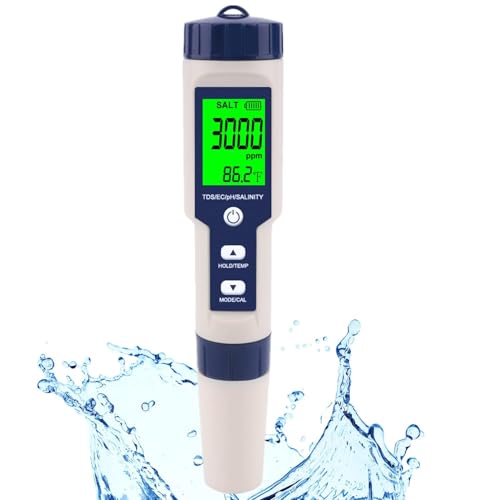
- Tests salinity, TDS, EC, pH, and temperature
- Food salinity range from 0.01% to 25%
- Displays ppm, ppt, and percent
Best For: Mixed kitchen and general water-monitoring needs
Fast Kitchen Salt Check

- 0–10% salt range with 0.01% low-range resolution
- Three-second readings and temperature measurement to 99 °C
- 304 stainless probe, IP66 body, and hanging hook
Best For: Routine soup, brine, stew, and marinade checks
Multi-Use Brine Control
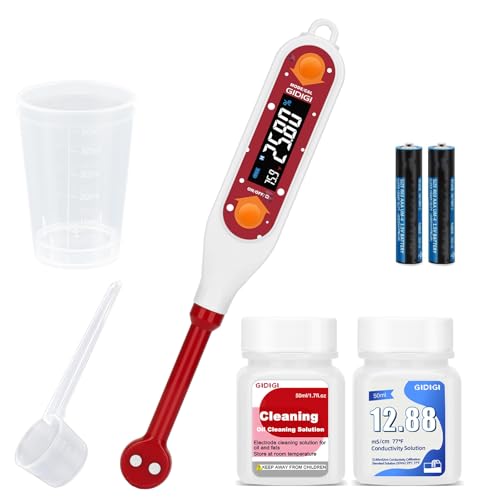
- Broad 0.01%–26.00% salinity range
- Adds EC, TDS, temperature, and specific-gravity readings
- Includes calibration and cleaning solutions plus a cup
Best For: Brines, fermented foods, sauces, and multi-purpose testing
Compact Salt Monitoring

- Designed for brines, soups, pickles, and fermented foods
- LED display with simple insert-and-read operation
- Lightweight handheld format for kitchen or processing use
Best For: Basic portable salt checks when simplicity matters
Best Multi-Parameter Pick – Apera PC60 5-in-1 Pocket Tester
For professional kitchens that need more than salt readings, the Apera PC60 is a versatile choice among salinity meters for professional kitchens. It measures pH, conductivity, TDS, salinity, and temperature, with dual-display readings and a replaceable probe.
Best For: Kitchens that monitor salinity alongside pH, conductivity, TDS, and temperature.
Pros:
- Measures five useful parameters in one pocket-sized tester.
- Large backlit LCD shows temperature alongside the selected measurement.
- Includes calibration solutions, storage solution, batteries, and a carrying case.
- Replaceable multi-parameter probe and a two-year instrument warranty.
Cons:
- More features than needed if you only measure salt content.
- Electrode warranty is limited to six months.
The PC60 is a strong all-around option for food operations that want one portable instrument for routine liquid checks. Its broader measurement range adds flexibility, though single-purpose users may prefer a simpler salt meter.
Best Dedicated Kitchen Salt Meter – LOHAND LH-SA10 Digital Salinity Meter
The LOHAND LH-SA10 is a focused choice among salinity meters for professional kitchens, covering 0–10% or 100 ppt. Its platinum-plated electrode and value-locking vibration are designed for quick checks of brine and other food liquids.
Best For: Brine, soups, sauces, pickles, seafood, and other high-salt kitchen solutions.
Pros:
- Measures both percentage salinity and parts per thousand.
- Platinum-plated electrode resists corrosion and impurity buildup.
- Vibrates and locks the reading for easier use in noisy work areas.
- Compact design includes batteries, cleaning cloth, and protective accessories.
Cons:
- Measures salinity rather than multiple parameters such as pH or temperature.
- Automatic shutdown may interrupt extended testing sessions.
For kitchens that mainly need consistent salt checks, the LH-SA10 keeps the workflow straightforward. Its stated range suits both lower- and higher-salinity food liquids, while the dedicated electrode design supports routine cleaning and use.
Best for Logged Testing – LaMotte Tracer 1749 PockeTester
LaMotte Tracer PockeTester, 1749, Salt, TDS, Temperature, Conductivity | Salt/TDS/Conductivity/Temp
Check Price On AmazonThe LaMotte Tracer PockeTester combines salt, TDS, temperature, and conductivity readings in a portable digital meter. Among salinity meters for professional kitchens, its built-in memory is especially useful when staff need to retain a record of recent measurements.
Best For: Operators who want multi-parameter testing with storage for up to 25 results.
Pros:
- Measures salt, TDS, temperature, and conductivity.
- Stores up to 25 test results for reviewing measurements over time.
- Compact PockeTester format supports portable, on-site testing.
Cons:
- The supplied notes do not specify a salinity measurement range.
- The listed two-pound weight is heavier than the other pocket testers in this roundup.
- Its notes emphasize water-quality monitoring rather than food-specific applications.
The Tracer is worth considering when measurement history matters as much as the current reading. Confirm that its stated salt range and intended sample workflow match your kitchen’s requirements before choosing it for food production.
Best for Flexible Salinity Units – Hanna HI98319 Salinity Tester
The Hanna HI98319 gives users a choice of parts per thousand, Practical Salinity Units, or specific gravity. That flexible readout makes it a useful option among salinity meters for professional kitchens when a particular measurement convention is required.
Best For: Users who need salinity results in ppt, PSU, or specific gravity.
Pros:
- Displays results in three salinity formats.
- Comes with necessary solutions and batteries for getting started.
- Designed for aquarium, field, and industrial salinity testing.
Cons:
- The supplied notes do not identify a food-kitchen-specific application.
- Only salinity output formats are listed; other kitchen parameters are not specified.
- Requires a CR2032 battery.
The HI98319 is a practical fit when unit flexibility is a priority. Because the supplied information highlights aquarium, field, and industrial use, professional food operations should verify that its specifications suit their samples and procedures.
Best All-in-One Testing Kit – Extech EC600
For professional kitchens that need more than salt readings, the Extech EC600 is a versatile choice among salinity meters for professional kitchens. Its 7-in-1 design measures salinity alongside conductivity, TDS, resistivity, pH, mV, and temperature.
Best For: Commercial kitchens and food-service teams that want one meter for salinity plus broader water-quality checks.
Pros:
- Measures salinity, conductivity, TDS, resistivity, pH, mV, and temperature.
- Includes automatic one-button pH calibration for pH 4, 7, and 10.
- Offers optional three-point pH calibration for improved accuracy.
- One-point conductivity calibration recognizes eight calibration solutions from multiple regional series.
Cons:
- Its many functions may be more than needed for teams seeking only salt measurements.
- The listed warranty is six months.
The EC600 is the most feature-rich option here, especially when kitchen water checks extend beyond salinity. Choose it when calibration flexibility and multiparameter testing matter more than a dedicated salt-only design.
Best Dedicated Food-Processing Meter – WQT-BM Salinometer
The WQT-BM is a focused option for food operations comparing salinity meters for professional kitchens. It is designed for food processing, provides selectable salinity ranges up to 26%, and displays results with 0.01% resolution.
Best For: Food-processing applications such as pickles, seafood, and other products where direct salt-concentration readings are the priority.
Pros:
- Offers salinity ranges of 0.01%–5%, 0.01%–10%, and 0.01%–26%.
- Provides 0–10,000 ppm TDS measurement.
- Produces results in about three seconds with 0.01% resolution.
- Waterproof and dustproof design supports use in demanding environments.
Cons:
- The shipped color is random.
- It is a more specialized instrument than a multiparameter water tester.
With its food-processing focus, broad selectable ranges, and quick display, the WQT-BM is a practical pick when salt concentration is the main measurement. Its one-year warranty is also longer than the Extech’s listed coverage.
Best Multipurpose Water Tester – Hofun 5-in-1 Salinity Meter
The Hofun 5-in-1 meter is a flexible choice for kitchens and facilities that also monitor pools, aquariums, or other water systems. Among salinity meters for professional kitchens, it stands out by combining salinity, TDS, EC, pH, and temperature testing in one compact device.
Best For: Teams that need kitchen food-salinity testing plus routine checks of pools, aquariums, hot tubs, or other water systems.
Pros:
- Combines salinity, TDS, EC, pH, and temperature functions.
- Displays salinity in ppm, ppt, or percent to simplify result reading.
- Supports food salinity testing from 0.01% to 25%.
- Titanium-alloy probe and quick measurement support convenient testing.
Cons:
- Its broader water-testing focus may be unnecessary for salt-only food checks.
- The supplied notes do not specify a warranty.
The Hofun offers the broadest application mix of the three, with a food salinity range reaching 25% and several water-quality modes. It is a sensible fit when one portable meter must serve both culinary and general water-monitoring tasks.
Fast Kitchen Salt Check – Digital Food Salinity Tester
For professional kitchens that need quick checks on soups, brines, and other liquid foods, this food-focused tester combines a 0–10% salt range with temperature measurement. Its 0.01% resolution at lower salinity, three-second response, stainless-steel probe, and large display make it practical for routine spot checks.
Best For: Kitchens checking everyday soup, noodle, brine, stew, and marinade salinity.
Pros:
- Measures 0–10% salt and displays temperature up to 99 °C.
- Shows salt percentage and sodium-ion readings with automatic conversion.
- Food-grade 304 stainless-steel probe, IP66 body, and fold-out hanging hook suit busy kitchens.
- Audio and LED completion alerts simplify the dip-and-read workflow.
Cons:
- The 10% upper salinity limit is narrower than some multipurpose meters.
- The notes describe calibration-free operation rather than user calibration controls.
- It uses two AAA batteries, even though batteries are included.
This is a focused choice when speed, readable results, and hot-liquid capability matter more than testing aquarium or water-quality parameters. The compact body and hanging hook also make it easy to keep near a prep station.
Multi-Use Brine Control – Portable Salinity Meter
Among salinity meters for professional kitchens, this portable model stands out for its broad 0.01%–26.00% salinity range and additional EC, TDS, temperature, and seawater-specific-gravity functions. It is designed for food preparation but can also support fermentation and marine-water testing.
Best For: Professional kitchens handling brines, fermented foods, sauces, and varied concentration ranges.
Pros:
- Covers salinity from 0.01% to 26.00%, including higher-salt fermentation applications.
- Also measures EC, TDS, temperature, and seawater specific gravity.
- Automatic temperature compensation supports more consistent readings.
- Includes calibration solution, cleaning solution, and a measuring cup.
Cons:
- Readings take less than 30 seconds, so it is slower than some dedicated testers.
- Hot samples should be cooled below 176 °F and skimmed if oily.
- The notes do not specify a Celsius temperature display.
This is the most versatile option of the three for kitchens that also monitor fermentation or need a higher salinity ceiling. Its included maintenance supplies and lock-on backlit display add practicality, but sample-temperature limits require planning during hot service.
Compact Salt Monitoring – Cabilock Digital Salt Tester
This compact Cabilock tester offers a straightforward way to check salt concentration in brines, soups, pickles, and fermented foods. Its handheld design and LED display make it suited to kitchens or food-processing areas where portability and simple operation are priorities.
Best For: Chefs and food processors wanting a lightweight, uncomplicated salt-checking tool.
Pros:
- Designed for brine, soup, pickle, and fermented-food measurements.
- Simple insert-and-read operation with an LED display.
- Small, lightweight body is easy to carry between prep areas.
- Positioned for home kitchens, restaurants, and food-processing use.
Cons:
- The supplied notes do not provide a numeric salinity range or resolution.
- They do not specify response time, temperature compensation, or calibration features.
- Unlike the other listed models, no probe material or splash-resistance rating is provided.
Cabilock is a sensible basic pick when you need a portable digital salt tester without a long feature list. Because key specifications are not supplied, buyers with strict process-control requirements should verify range, accuracy, and operating-temperature details before purchase.
How We Picked the Best Salinity Meters for Professional Kitchens
We focused on meters that can support real kitchen workflows, including brine preparation, food processing, pickling, fermentation, and quality checks. The selection includes dedicated salt testers as well as multiparameter instruments that may be useful when a kitchen also monitors pH, conductivity, or temperature.
Important comparison points include stated salinity range, resolution, probe construction, waterproofing, reading speed, portability, calibration features, and suitability for repeated commercial use. Because measurement methods and scales vary, users should confirm that a meter’s specifications match the type of sample being tested.
Quick Comparison
- Best for broad testing: Choose a multiparameter meter if you need salinity alongside pH, EC, TDS, or temperature.
- Best for food-specific work: Dedicated 0–10% salt meters are convenient for brines, soups, sauces, and prepared foods.
- Best for higher salt concentrations: Look for models rated in ppt or with ranges extending beyond ordinary culinary brines.
- Best for portability: Pocket testers with automatic or fast readings are practical for checking multiple batches.
- Best for wet environments: Waterproof or IP-rated bodies and sealed controls help protect against routine splashes.
Key Buying Factors for Salinity Meters for Professional Kitchens
Measurement Range and Resolution
Match the range to your recipes. A 0–10% tester may be ideal for many food applications, while seafood processing, concentrated brines, or other specialized work may require a wider ppt range. Resolution indicates how finely the instrument displays changes, but it does not by itself guarantee accuracy.
Food Compatibility and Probe Design
Consider whether the probe is designed for liquid food samples and whether it can be cleaned easily between batches. Stainless-steel probes are convenient for kitchen use, but always follow the manufacturer’s cleaning and storage instructions. Avoid cross-contamination by rinsing between samples.
Calibration, Temperature, and Maintenance
Calibration support is essential for dependable readings over time. Automatic temperature compensation can improve consistency when samples vary in temperature, while an integrated thermometer can help identify readings taken outside the meter’s recommended operating conditions. Check whether calibration solutions, replacement probes, or storage accessories are readily available.
Durability and Workflow
For professional kitchens, waterproof construction, readable displays, simple controls, and quick stabilization can matter more than a long list of extra functions. A compact meter is easier to carry between prep stations, while a larger kit may be preferable for a fixed quality-control area.
Who Should Buy Which Salinity Meters for Professional Kitchens?
Commercial food producers and quality-control teams should prioritize calibration, repeatability, serviceability, and a range suited to their specific recipes. Restaurants and catering operations may prefer a fast, portable food salinity tester for routine brine and sauce checks. Fermentation and pickling users should look for fine resolution, temperature awareness, and easy cleaning. Kitchens with broader testing needs may get better value from a multiparameter model that combines salinity with pH, EC, TDS, or temperature.
Before buying, verify the measurement scale, intended sample type, calibration procedure, and cleaning requirements. The best salinity meter is the one that delivers repeatable readings without slowing down your preparation and quality-control process.