Reliable pH measurement supports safer recipes, consistent fermentation, and better quality control in professional kitchens. The right meter should match your ingredients, workflow, accuracy needs, and cleaning routine.
We compared 10 food-focused and general-purpose testers, including spear-probe models for sauces and semi-solid foods, waterproof pocket meters, and benchtop systems for repeatable lab-style testing.
Best 10 Ph Meters for Professional Kitchens Picks for 2026
Best Food-Sample Precision

- Food-grade replaceable spear sensor
- ±0.01 pH accuracy with ATC
- Includes calibration and storage accessories
Best For: Cheese, dairy, sauces, rice, and semi-solid foods
Best for Data Tracking
- Bluetooth app connectivity
- Stores up to 1,000 readings
- Designed for canning and fermentation
Best For: Recordkeeping-heavy fermentation and food-processing workflows
Best General-Purpose Option
Apera PH60 Waterproof Pocket Tester

- ±0.01 pH accuracy
- Replaceable glass probe
- Automatic calibration and temperature compensation
Best For: Beverages, water, and general liquid-solution testing
Best Value Food Spear Probe
- Spear probe for semi-solid foods
- Detachable and water-resistant design
- Includes calibration and protection solutions
Best For: Fermentation, canning, sauces, dairy, and meat testing
Best Value Portable Tester
Apera PH20 Waterproof pH Tester

- ±0.1 pH accuracy with ATC
- Auto calibration and stable readings
- Case, buffers, and batteries included
Best For: Portable routine testing of kitchen liquids
Best for Food Fermentation

- 0.01 pH readings with ATC
- Spear probe for semi-solid foods
- Replaceable electrode and buffer kit
Best For: Ferments, cheeses, dough, meats, and sauces
Best Benchtop Option
- 0.01 pH accuracy with ATC electrode
- One- to three-point auto calibration
- 50 sets of data storage
Best For: Stable bench testing and repeatable workflows
Precision Pick

- ±0.01 pH accuracy with temperature readings
- Replaceable glass-membrane sensor probe
- Includes KCL and three calibration solutions
Best For: Liquid testing and kitchens that value ongoing probe replacement
Rugged Liquid Tester

- IP67 waterproof specification
- Flat surface electrode and LCD display
- Reusable design with protective sensor cap
Best For: Moisture-heavy kitchens and general liquid pH checks
Food-Focused Choice

- Spear probe for soft solid foods
- ±0.01 accuracy with 0.00–14.00 range
- ATC and KCL-moistened storage cap
Best For: Fermented foods, sauces, meats, cheeses, and canned products
Best Food-Sample Precision – Apera PH60S Food pH Meter
For professional kitchens looking for dependable pH meters for professional kitchens, the Apera PH60S is designed specifically for solid and semi-solid food samples. Its food-grade Swiss spear electrode, ±0.01 pH accuracy, and temperature compensation make it well suited to routine testing across a broad range of ingredients and preparations.
Best For: Testing cheese, sushi rice, fruit, dairy, sauces, and other solid or semi-solid foods.
Pros:
- Food-grade, replaceable Swiss spear sensor is designed for food samples.
- Offers ±0.01 pH accuracy with automatic temperature compensation.
- High/low alarms and a three-color backlit display make readings easier to interpret.
- Includes calibration solutions, storage solution, batteries, and a carrying case.
Cons:
- The feature-rich kit may be more than needed for occasional basic testing.
- The supplied notes do not specify Bluetooth connectivity or data logging.
The PH60S is the strongest fit here when direct penetration of food samples and repeatable, professional-style measurements matter most. Its replaceable probe and complete accessories also support ongoing kitchen use.
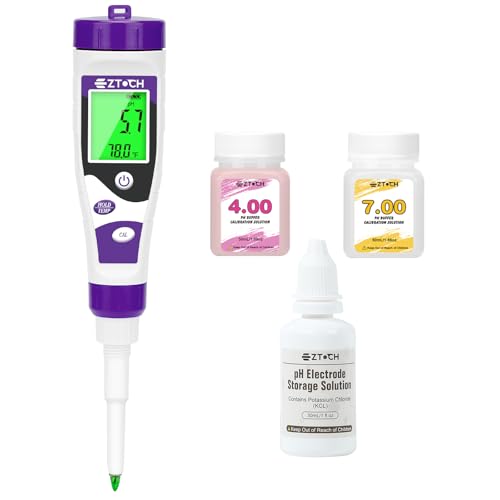
Best for Data Tracking – YINMIK Smart Food pH Meter
This smart tester stands out among pH meters for professional kitchens for its Bluetooth connection and built-in data storage. It is geared toward kitchens that need to monitor fermentation, canning, brewing, or other food-processing measurements and keep a record of results.
Best For: Canning, sourdough, fermentation, brewing, and kitchens that need measurement history.
Pros:
- Bluetooth connectivity works with the YINMIK app for saving and reviewing readings.
- Can automatically store up to 1,000 data points.
- Supports applications including sauces, dairy, kombucha, beer, wine, pickles, and jams.
- Includes pH 4.00 and 7.00 calibration solutions plus probe protective solution.
Cons:
- The notes do not provide a specific accuracy rating or measurement range.
- App-based features may be unnecessary for kitchens that only need occasional readings.
If documentation and trend tracking are priorities, this model offers a useful advantage over simpler handheld meters. Its broad food and fermentation applications make it a versatile choice, though buyers seeking a stated precision specification may prefer a model with published accuracy details.
Best General-Purpose Option – Apera PH60 Waterproof Pocket Tester
The Apera PH60 is a compact choice for kitchens that need accurate readings from liquids and general water solutions. Among pH meters for professional kitchens, it offers ±0.01 pH accuracy, automatic temperature compensation, and a replaceable glass probe in a portable kit.
Best For: Beverage, water, pool, hydroponic, environmental, and other regular liquid-solution testing.
Pros:
- Provides ±0.01 pH accuracy across a -2.00 to 16.00 pH range.
- Supports one- to three-point automatic calibration and recognizes five solution types.
- Automatic temperature compensation helps maintain accuracy from 32° to 122°F.
- Includes calibration solutions, storage solution, batteries, and a rugged carrying case.
Cons:
- The standard glass probe is aimed at regular water solutions rather than specialized solid-food testing.
- It does not list Bluetooth connectivity or measurement-history storage.
Choose the PH60 when your kitchen primarily checks beverages, water, or other liquid solutions and values a replaceable probe and clear stability indicators. For frequent cheese, meat, or other semi-solid testing, the food-specific PH60S is a more targeted alternative.
Best Value Food Spear Probe – GIDIGI Fermentation pH Meter
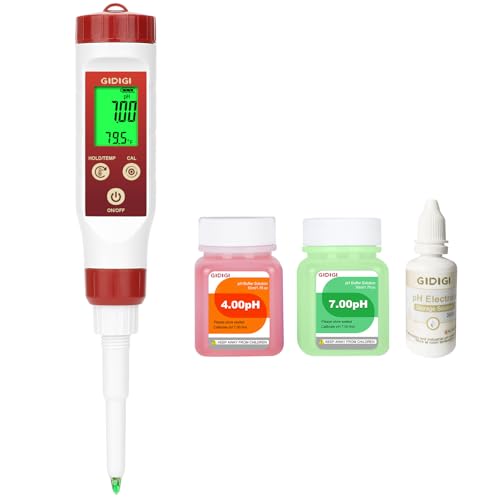
The GIDIGI food pH meter is a practical entry point for kitchens that need to test both liquids and semi-solid foods. Its spear-shaped probe, detachable design, water-resistant construction, and included solutions make it a flexible option among pH meters for professional kitchens.
Best For: Fermentation, canning, sauces, dairy, meat, bread, kombucha, and all-grain brewing.
Pros:
- Spear tip penetrates semi-solid foods such as cheese, meat, and bread.
- Detachable probe can support longer service life and replacement flexibility.
- Includes pH 4.00 and 7.00 calibration solutions and electrode protection solution.
- Water-resistant construction is suited to wet kitchen environments and easier cleanup.
Cons:
- The supplied notes do not state a specific accuracy rating.
- Additional pH 10.01 solution is needed for alkaline-food calibration.
- The notes do not mention Bluetooth or automatic data logging.
GIDIGI is a sensible choice for broad food testing when a spear probe matters more than advanced recordkeeping. Its included calibration materials and detachable probe add practical value for regular fermentation and canning work.
Best Value Portable Tester – Apera PH20 Waterproof pH Tester
APERA INSTRUMENTS AI209 Value Series PH20 Waterproof pH Tester Kit, ±0.1 pH Accuracy
Check Price On AmazonFor professionals comparing ph meters for professional kitchens, the Apera PH20 is a practical portable option for routine liquid measurements. It offers automatic buffer recognition, automatic temperature compensation, and stable-value recognition in a waterproof pen-style design.
Best For: Kitchen teams needing a portable tester for liquids, prep areas, or outdoor use.
Pros:
- ±0.1 pH accuracy with automatic temperature compensation from 32°F to 122°F.
- Automatic calibration and stable-value recognition simplify routine testing.
- Includes a carrying case, pH 4 and 7 buffers, lanyard, and AAA batteries.
- Up to 2,000 hours of continuous operation.
Cons:
- Its stated accuracy is lower than meters rated to 0.01 pH.
- The included electrode is not described as replaceable in the supplied notes.
The PH20 stands out for straightforward field use and long battery life. It is a sensible value pick when convenience and portability matter more than bench-top features or ultra-fine resolution.
Best for Food Fermentation – GIDIGI Spear Probe pH Meter
Among ph meters for professional kitchens, this GIDIGI model is designed for foods that are difficult to test with a flat probe. Its spear tip reaches into semi-solid products, while automatic temperature compensation supports readings across 32°F to 140°F.
Best For: Fermentation, cheesemaking, dough, cured meats, sauces, kombucha, and other semi-solid or acidic foods.
Pros:
- 0.01 pH readings with automatic temperature compensation.
- Replaceable spear electrode is suited to dough, meat, and cheese.
- Includes pH 4.00, 7.00, and 10.01 buffer solutions and a carrying case.
- Backlit display, waterproof body, and temperature measurement add practical flexibility.
Cons:
- Its stated response time is about 30 seconds, so it is not an instant-reading tool.
- The spear design is specialized and may be less convenient for general liquid-only checks.
This is the most food-specific option in the group. The replaceable spear probe and broad application list make it particularly useful for professional kitchens that monitor fermentation or need to test solid and semi-solid foods.
Best Benchtop Option – Apera PH700 Benchtop pH Meter
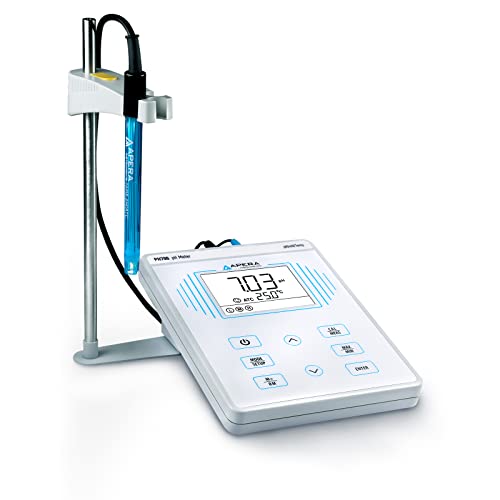
For a fixed work area, the Apera PH700 offers a more structured approach than handheld ph meters for professional kitchens. This benchtop unit combines 0.01 pH accuracy, automatic calibration, temperature measurement, and limited data storage for repeatable testing.
Best For: Commercial prep stations, test benches, and kitchens that prefer a stable benchtop workflow.
Pros:
- Provides 0.01 pH accuracy with a 3-in-1 pH/temperature electrode.
- Supports one to three points of automatic calibration with self-diagnosis.
- Stores 50 sets of data and offers maximum/minimum reading modes.
- Includes an electrode holder and pH 4, 7, and 10 calibration solutions.
Cons:
- Its benchtop format is less portable than a pen-style tester.
- The IP54 rating is spill-proof and dust-proof, but it is not described as waterproof.
- The supplied electrode is specified for general water solutions.
The PH700 is the strongest choice here for organized bench work and record-oriented testing. Choose it when calibration controls, electrode management, and stored readings are more important than portability.
Precision Pick – AC Infinity pH Meter PRO Kit
For professional kitchens that also monitor water, brewing, or other liquid processes, this AC Infinity meter offers a versatile way to check acidity, alkalinity, and temperature. Its replaceable probe and included calibration solutions make it a practical option among pH meters for professional kitchens, particularly where ongoing maintenance matters.
Best For: Kitchens needing a durable, multipurpose meter for liquid testing and regular calibration.
Pros:
- Measures pH and temperature with stated ±0.01 pH accuracy.
- Replaceable glass-membrane sensor probe supports longer-term use.
- Includes KCL and pH 4.00, 7.00, and 10.01 calibration solutions.
- IP67-rated construction is sealed against high-volume moisture, dust, and sand.
Cons:
- The notes focus on water and liquid applications rather than direct testing of solid foods.
- Its broader gardening, aquarium, pool, and brewing feature set may be more than a kitchen needs.
This is a strong general-purpose choice when a kitchen wants replaceable-probe convenience, high stated accuracy, and a complete calibration kit for liquid measurements.
Rugged Liquid Tester – Extech PH100 ExStik II
The Extech PH100 is a waterproof digital pH meter with an LCD temperature display and flat surface electrode. For professional kitchens looking for pH meters for professional kitchens that can handle wet working conditions, its IP67 specification and reusable design are useful features, although the supplied notes provide limited detail about food-specific testing.
Best For: Wet kitchen environments and users who want a reusable waterproof meter with temperature display.
Pros:
- IP67 waterproof specification suits moisture-heavy work areas.
- Flat surface electrode is included for the stated PH100 kit configuration.
- Provides an LCD display and reusable construction.
- Includes a protective sensor cap and offers a one-year meter warranty.
Cons:
- The notes do not state a pH accuracy figure or calibration-solution package.
- Its listed temperature range and probe details may be more relevant to general measurement than food-specific applications.
Choose this model when waterproofing and a flat electrode are priorities; compare its unspecified accuracy and calibration details with food-focused meters before relying on it for critical process controls.
Food-Focused Choice – GISNPA Spear Probe pH Tester
Designed specifically for food samples, this GISNPA meter uses a spear probe for soft solids such as meats, cheeses, rice, doughs, jams, and sauces. Its 0.00–14.00 range, stated ±0.01 accuracy, backlit display, and automatic temperature compensation make it one of the more directly relevant pH meters for professional kitchens handling fermented or canned foods.
Best For: Fermentation, sauce, canned-food, and other soft-solid food testing.
Pros:
- Spear probe is designed for inserting into soft solid food samples.
- Offers a 0.00–14.00 range and stated ±0.01 accuracy.
- Automatic temperature compensation helps account for temperature changes.
- Includes a KCL-moistened sponge in the cap and supports pH 4.00 and 7.00 calibration.
Cons:
- Its specialized spear probe may be less convenient for routine liquid-only testing.
- The supplied notes do not mention waterproof or IP-rated construction.
- It requires four LR44 batteries.
Among these options, this is the clearest match for kitchens testing food directly rather than only water. Proper probe care and calibration remain important, but the food-specific design makes it especially suitable for fermentation and sauce work.
How We Picked the Best Ph Meters for Professional Kitchens
We evaluated these meters by looking at the features that matter in commercial food preparation: stated accuracy and resolution, probe design, calibration options, temperature compensation, waterproofing, replaceable electrodes, display readability, and likely maintenance demands. Food applications often require more than a basic water-testing pen, so spear and flat-surface electrodes received particular attention for products such as sauces, salsa, jams, fermented foods, and canned recipes.
We also included a range of formats and prices. Pocket testers are convenient for checks throughout a kitchen, while benchtop meters can be a better fit for controlled production areas that need repeatable measurements and a stable workstation.
Quick Comparison
For semi-solid or thick foods, prioritize a food-specific spear probe, such as those found on the Apera PH60S and comparable fermentation-oriented meters. For general liquid testing, a waterproof pocket tester like the Apera PH60 or PH20 is easier to store and use. The Apera PH700 is the strongest choice for a dedicated bench setup, offering a larger instrument format and multi-point calibration. The Extech PH100 stands out when a flat-surface electrode and temperature display are useful, while the AC Infinity model is worth considering if a replaceable sensor is a priority.
Key Buying Factors for Ph Meters for Professional Kitchens
Probe Type and Food Compatibility
Choose a spear electrode for foods that are thick, soft, or particulate. A flat-surface probe can be useful for shallow samples and smooth surfaces. Standard pen electrodes are generally best for liquids and thin mixtures. Always confirm that the probe materials and cleaning instructions are suitable for food-contact testing.
Accuracy, Resolution, and Calibration
Higher stated accuracy is valuable when measurements affect a recipe’s consistency or a documented process. Resolution is not the same as accuracy: a display showing two decimal places does not guarantee laboratory-level precision. Look for automatic calibration, multiple calibration points, and included buffer solutions. Calibrate on the schedule recommended by the manufacturer and whenever readings appear unstable.
Temperature Compensation and Operating Conditions
Temperature can influence pH readings. Automatic temperature compensation, or ATC, helps account for changing sample temperatures, but it does not replace proper sample preparation or calibration. Waterproof construction is useful around sinks and production areas, though the meter should still be rinsed and stored correctly.
Maintenance and Total Cost
Probe care often determines the useful life of a pH meter. Budget for storage solution, calibration buffers, cleaning solution, and eventual electrode replacement. A replaceable probe may cost more initially but can be more economical than replacing an entire meter.
Who Should Buy Which Ph Meters for Professional Kitchens?
Choose a food-specific spear-probe meter if you regularly test salsa, hot sauce, preserves, fermented foods, or other thick mixtures. Select a waterproof pocket tester for quick liquid checks and portability. Choose a benchtop model if your kitchen has a dedicated quality-control station and needs stable, repeatable measurements. A flat-surface electrode is a practical option for shallow or smooth samples, while a lower-cost basic tester may suit occasional, noncritical checks.
Whichever model you choose, use clean representative samples, follow the manufacturer’s calibration procedure, and treat pH readings as one part of a broader food-safety and quality-control process.