A reliable temperature controller can help a chest freezer hold a steadier temperature for specialty food storage, home brewing, fermentation, or other kitchen projects. The right model depends on whether you need a simple plug-in outlet or a more advanced thermostat with separate heating and cooling control.
We compare 10 freezer temperature controllers for home kitchens across temperature range, load capacity, sensor design, controls, and installation requirements, so you can choose a practical fit without paying for features you will not use.
Best 10 Freezer Temperature Controllers for Home Kitchens Picks for 2026
Best Plug-and-Play Pick

- Controls heating and cooling equipment
- Simple probe-and-outlet setup
- Celsius/Fahrenheit display with calibration
Best For: Home fermentation, coolers, and general freezer projects
Best Budget Freezer Conversion

- Made for chest-freezer conversions
- Simple wall-plug and sensor setup
- Economical design
Best For: Basic keg refrigerator and freezer conversion projects
Best Feature-Rich Outlet Controller

- Heating and cooling control from -22°F to 221°F
- Alarm for temperature or sensor issues
- Memory and compressor-delay functions
Best For: Freezer conversions and multi-purpose appliance control
Best Advanced Refrigeration Controller

- Controls compressor, fan, and defrost relays
- Uses two NTC probe inputs
- Designed for multiple refrigeration systems
Best For: Technical refrigerator, freezer, wine cooler, and beer equipment installations
Reliable High-Power Pick
DEWENWILS 15A Heating and Cooling Controller

- -40°F to 210°F range with 0.1°F precision
- 15A, 1,800W output for compatible equipment
- Memory, calibration, and timer functions
Best For: Versatile refrigerator, freezer, and home-brewing setups
Feature-Packed Kitchen Pick
226T Digital Temperature Controlled Outlet

- -40°F to 212°F heating and cooling control
- 6.6-foot IP67 waterproof probe
- Backlit display, memory, child lock, and timers
Best For: Freezer, refrigerator, fermentation, and probe-based monitoring
Dual-Stage Control Pick
Inkbird ITC1000 Digital Thermostat

- Controls heating and cooling outputs
- Fahrenheit display with sensor and high-temperature alarms
- Compact 110-volt controller design
Best For: Dual-stage freezer, refrigerator, and temperature-control projects
Most Versatile
Programmable Heating & Cooling Controller
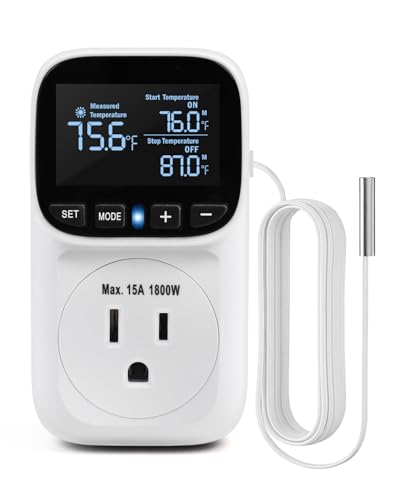
- -40°F to 210°F range with 0.1°F accuracy
- Heating, cooling, and multiple timer modes
- 15A/1800W resistive-load capacity
Best For: Freezers, refrigerators, fermentation, and multipurpose temperature control
Simple Plug-and-Play Pick

- Large LCD with °F/°C support
- Waterproof silicone temperature sensor
- 10A/1100W stated output at 110V
Best For: Basic freezer, refrigerator, and fermentation temperature control
Higher-Capacity Choice
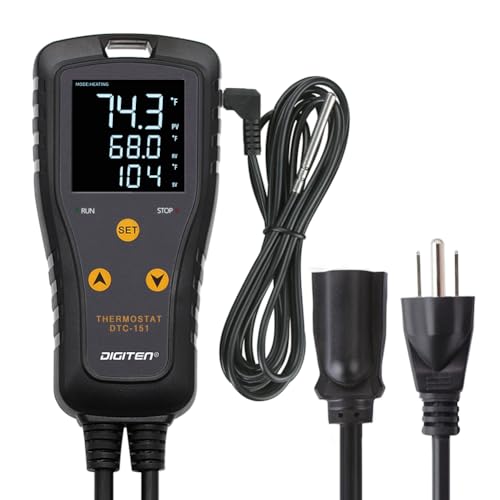
- Heating and cooling temperature control
- 15A/1650W stated output at 110V
- Large LCD with waterproof silicone sensor
Best For: Higher-load freezers, refrigerators, and homebrew setups
Best Plug-and-Play Pick – Inkbird ITC-308
For home kitchens seeking freezer temperature controllers, the Inkbird ITC-308 offers a straightforward way to manage heating and cooling equipment. Set the temperature range, position the probe, and connect your appliances to the marked outlets.
Best For: Home fermentation, kombucha, greenhouse projects, and freezer or cooler temperature control.
Pros:
- Supports heating and refrigeration equipment at the same time.
- Simple plug-in setup with adjustable temperature ranges.
- Supports Celsius and Fahrenheit displays.
- Temperature probe can be calibrated.
Cons:
- Its supplied notes do not specify a dedicated alarm feature.
- The controller is designed for 110V equipment and has a stated 1200W capacity.
The ITC-308 is a practical general-purpose choice when easy installation and dual heating/cooling control matter more than advanced refrigeration-specific functions.
Best Budget Freezer Conversion – Johnson Controls A19AAT-2C
Among freezer temperature controllers for home kitchens, the Johnson Controls A19AAT-2C is a simple, economical option for converting a chest freezer into a keg refrigerator. Plug the unit into the wall and place its sensor inside the freezer.
Best For: Basic chest-freezer-to-refrigerator conversions and keg refrigeration.
Pros:
- Designed for turning a chest freezer into a keg refrigerator.
- Simple installation and operation.
- Economical compared with more feature-rich controllers.
Cons:
- The supplied notes do not mention a digital display.
- The notes do not specify heating control or advanced alarm functions.
- Its larger listed dimensions may require more placement space.
This controller suits shoppers who want a focused, low-cost solution for a freezer conversion and do not need extensive programming features.
Best Feature-Rich Outlet Controller – DEWENWILS Temperature Outlet
The DEWENWILS is a versatile option among freezer temperature controllers for home kitchens, combining heating and cooling modes with a wide -22°F to 221°F control range. Its LCD, alarm, memory function, and compressor delay add useful convenience for refrigerator and freezer projects.
Best For: Freezer conversions, brewing, aquariums, terrariums, greenhouse equipment, and other wired appliances.
Pros:
- Supports both heating and cooling with a broad temperature range.
- Includes a buzzer alarm for out-of-range temperatures or sensor faults.
- Power-off memory, Celsius/Fahrenheit display, and temperature calibration.
- Compressor-delay function helps protect connected equipment.
Cons:
- Limited to a 120VAC, 10A/1200W rating.
- The wired probe should not be immersed in water.
- Requires corded-electric installation and compatible load limits.
With its alarm and compressor protection, the DEWENWILS is a strong choice when a home kitchen setup needs more monitoring and control than a basic thermostat outlet provides.
Best Advanced Refrigeration Controller – Dixell XR06CX-4N1F1
For shoppers comparing freezer temperature controllers for home kitchens with more specialized refrigeration needs, the Dixell XR06CX-4N1F1 provides microprocessor-based control for medium- and low-temperature ventilated refrigeration systems. Its relay outputs are designed to manage compressor, fan, and defrost functions.
Best For: Upright or mini freezers, refrigerators, wine coolers, beer equipment, and other refrigeration installations.
Pros:
- Three relay outputs can control the compressor, fan, and defrost.
- Two NTC probe inputs support temperature and defrost management.
- Broad compatibility with several refrigerator and freezer types.
- Includes mounting hardware.
Cons:
- Its installation may be more involved than a plug-in outlet controller.
- Power should be disconnected before linking the instrument.
- Although moisture-resistant, it should not be exposed directly to water or moisture for long periods.
The XR06CX-4N1F1 is best suited to users comfortable with a more technical installation who need coordinated compressor, fan, and defrost control rather than a simple plug-in thermostat.
Reliable High-Power Pick – DEWENWILS 15A Heating and Cooling Controller
For shoppers comparing freezer temperature controllers for home kitchens, the DEWENWILS controller offers broad temperature coverage, heating and cooling modes, and a high-power 15A outlet. Its VA display, memory function, and calibration controls make it practical for refrigerators, freezers, home brewing, and other temperature-sensitive setups.
Best For: Home kitchens needing a versatile controller for a refrigerator, freezer, or other 120-volt heating and cooling application.
Pros:
- Supports heating and cooling across a -40°F to 210°F range with 0.1°F precision.
- 15A output supports up to 1,800W for compatible equipment.
- Includes power memory, temperature calibration, and multiple timer modes.
- Self-illuminating VA display is designed to remain readable in dark environments.
Cons:
- The supplied notes do not specify a waterproof probe.
- Its push-button control and timer features may be more than needed for simple freezer monitoring.
The DEWENWILS is a feature-rich option when you want one controller to handle both heating and cooling. Confirm that your appliance’s electrical load is compatible with the 15A, 1,800W rating before use.
Feature-Packed Kitchen Pick – 226T Digital Temperature Controlled Outlet
This 226T outlet is a strong candidate among freezer temperature controllers for home kitchens, especially if you value a backlit display, waterproof sensor, and automatic setting retention after a power outage. It supports both heating and cooling and offers timer modes for more flexible temperature management.
Best For: Users who want a plug-in controller with a long waterproof probe, child lock, and visible display for refrigerator, freezer, fermentation, or other applications.
Pros:
- Controls temperatures from -40°F to 212°F and supports heating or cooling modes.
- Includes a 6.6-foot IP67 waterproof probe.
- Backlit LCD is designed for easy reading in darkness.
- Offers calibration, power-outage memory, child lock, and timer modes.
Cons:
- The supplied details list a maximum output of 16A/1,800W at 120V; compatibility should be checked before connecting equipment.
- Its gray ABS housing and 3.6-by-3.5-by-5.3-inch dimensions may take more space than a basic outlet adapter.
The 226T stands out for monitoring flexibility and sensor protection. Its waterproof probe and memory features are useful where the sensor location or occasional power interruptions make a simple thermostat less convenient.
Dual-Stage Control Pick – Inkbird ITC1000 Digital Thermostat
The Inkbird ITC1000 is a compact dual-stage thermostat for shoppers seeking freezer temperature controllers for home kitchens and similar equipment. It can control heating and cooling outputs, displays temperatures in Fahrenheit, and includes alarms for sensor failure or high-temperature conditions.
Best For: Users who need a compact dual-stage controller for a freezer, fridge, hatching setup, or other 110-volt temperature-control project.
Pros:
- Controls both heating and cooling output.
- Supports Fahrenheit temperature readings.
- Includes alarms for sensor failure and high temperature.
- Designed as a compact controller measuring 3.93 by 3.77 by 1.49 inches.
Cons:
- The supplied notes do not list the temperature-control range or calibration features.
- The notes do not specify a waterproof sensor or built-in timer.
- Its 110-volt controller format may require more installation planning than a plug-in outlet controller.
The ITC1000 is best suited to buyers prioritizing dual-stage control and alarm functionality over plug-and-play convenience. Review the wiring and installation requirements carefully for your intended freezer or refrigerator setup.
Most Versatile – Programmable Heating & Cooling Controller
For shoppers comparing freezer temperature controllers for home kitchens, this programmable outlet stands out for its broad temperature range and flexible operating modes. It measures from -40°F to 210°F with 0.1°F accuracy, supports heating and cooling, and includes timer functions for more automated control.
Best For: Home kitchens, freezers, refrigerators, fermentation setups, and other applications needing precise heating or cooling control.
Pros:
- Measures -40°F to 210°F with stated 0.1°F accuracy.
- Supports heating, cooling, cycle, delay, and countdown modes.
- Handles up to 15A/1800W resistive loads and includes calibration.
- Backlit LCD is readable in dark areas and automatically turns off after about 30 seconds.
Cons:
- Uses push-button controls rather than app-based operation.
- Its many timer and control functions may be more than needed for simple freezer monitoring.
This is the most feature-rich option of the three, especially if you want one controller for both temperature regulation and timed operation. Verify that your appliance’s electrical requirements are compatible with the stated 15A/1800W resistive-load rating.
Simple Plug-and-Play Pick – 10A Digital Thermostat
This simple-stage thermostat is a practical entry point for shoppers seeking freezer temperature controllers for home kitchens. Its plug-and-play format, waterproof silicone sensor, large LCD, and Fahrenheit/Celsius support make basic temperature programming straightforward.
Best For: Chest freezers, refrigerators, homebrew fermenters, greenhouses, and other setups with loads up to 10A.
Pros:
- Plug-and-play design with a large, glare-free LCD screen.
- Supports both Fahrenheit and Celsius readings.
- Includes a waterproof silicone temperature sensor.
- Offers temperature correction and delay-start protection.
Cons:
- Its maximum stated current is 10A, lower than the 15A model in this lineup.
- The supplied details identify it as a simple-stage controller, limiting its appeal for more complex setups.
Choose this model when ease of setup and readable controls matter more than higher capacity or extensive programming. Its 12-month warranty adds useful coverage for a basic home temperature-control installation.
Higher-Capacity Choice – 15A Simple-Stage Thermostat
For home kitchens needing a higher-capacity option, this 15A thermostat provides plug-and-play heating and cooling control for freezers and refrigerators. It combines a waterproof silicone sensor, large LCD, temperature correction, and delay-start protection in a compact controller.
Best For: Chest freezers, refrigerators, homebrew equipment, and other compatible appliances drawing up to 15A.
Pros:
- Supports heating and cooling modes.
- Rated up to 15A/1650W at 110V, according to the supplied specifications.
- Large LCD supports Fahrenheit and Celsius readings.
- Includes a waterproof silicone NTC sensor and delay-start protection.
Cons:
- It is a simple-stage controller, so it may not suit users seeking extensive timer programming.
- The supplied details describe button controls and do not establish smart-home connectivity.
This is the stronger choice over the 10A version when your setup benefits from the higher stated current rating. As with any plug-in controller, match the appliance and load requirements to the controller’s specifications before installation.
How We Picked These Freezer Temperature Controllers for Home Kitchens
We focused on controllers that can regulate cooling equipment through an external probe and that are suitable for common household applications such as chest freezers, refrigerators, fermentation chambers, and temperature-sensitive storage. The selection includes plug-in controllers for straightforward setup as well as panel-style and programmable units for users who need more control.
We compared stated temperature ranges, heating and cooling modes, maximum electrical ratings, probe arrangements, display clarity, adjustment controls, and installation complexity. Because freezer compressors can have demanding startup loads, the listed wattage or amperage should be treated as a compatibility reference rather than a guarantee for every appliance.
Quick Comparison
| Controller type | Best suited to | Main advantage | Watch for |
|---|---|---|---|
| Plug-in heating/cooling outlet | Most home users | Fast, low-effort setup | Outlet and compressor-load limits |
| Dual-stage thermostat | Fermentation and specialty storage | Can manage heating and cooling | More settings and wiring |
| Commercial digital controller | Configured refrigeration systems | Programmable control and broader use | May require installation knowledge |
| Simple-stage thermostat outlet | Basic chest-freezer control | Easy temperature adjustment | Fewer advanced features |
Key Buying Factors
Temperature Range and Accuracy
Choose a range that covers your intended set point with room for adjustment. A readable digital display and a suitably placed probe are often more useful than an unusually broad advertised range. Check whether the controller displays Fahrenheit, Celsius, or both.
Electrical Capacity and Compressor Protection
Compare the controller’s voltage, amperage, and wattage ratings with the freezer’s requirements. Refrigerators and freezers can draw more power briefly when the compressor starts. Look for an adjustable delay or compressor-protection feature when available, and avoid exceeding the stated rating or using questionable extension cords.
Plug-In Simplicity Versus Wired Installation
Plug-in models are generally the easiest choice for a home kitchen: connect the freezer to the controller, position the probe, and configure the set point. Panel-mount or commercial-style controllers may offer more precise programming but can require electrical knowledge, an enclosure, or professional installation.
Probe Placement and Environmental Protection
Secure the sensor where it measures the food-storage environment rather than warm room air. Keep the probe cable protected from sharp edges, moisture, and the freezer lid seal. Confirm that the sensor and controller are appropriate for the damp conditions around your setup.
Who Should Buy Which Freezer Temperature Controllers for Home Kitchens?
Choose a plug-in controller if you want the simplest solution for a chest freezer, refrigerator, or occasional home-brewing project. Choose a dual-stage model if you need both heating and cooling for fermentation or seasonal temperature changes. Choose a commercial-style digital controller if you are replacing an existing refrigeration control system and are comfortable verifying wiring, voltage, and sensor compatibility.
Before buying, confirm the freezer’s electrical specifications, the controller’s operating range, included probe type, and return or support options. For most home kitchens, a properly rated plug-in unit with a clear display and compressor-friendly controls offers the best balance of safety, convenience, and value.