Making fresh peanut, sesame, walnut, or sunflower oil at home is easier when you choose a press that matches your available counter space, batch size, and cleanup routine.
This roundup compares 10 oil presses for small kitchens, from space-saving manual designs to higher-powered automatic machines for frequent home use.
Best 10 Oil Presses for Small Kitchens Picks for 2026
High-Capacity Electric Pick

- Automatic hot and cold pressing
- Temperature range of 104–464°F
- Large capacity with included filter and accessories
Best For: High-volume home seed and nut pressing
Compact Manual Choice
Gralara Small Kitchen Oil Press

- Hand-crank operation without electricity
- Stainless-steel construction
- Includes a collection bottle
Best For: Simple occasional home pressing
Versatile Electric Pick
Garvee 900W Hot and Cold Press
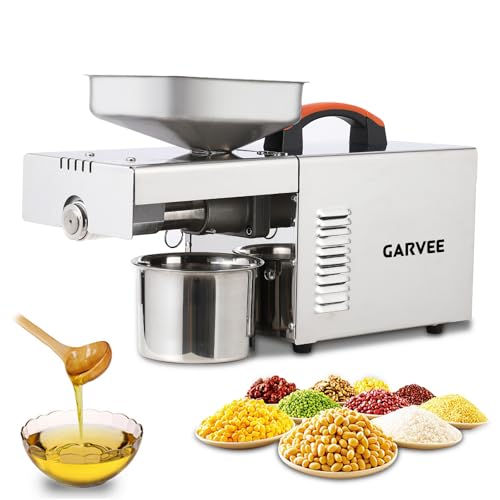
- Hot, cold, and frying settings
- 304 food-grade stainless-steel build
- Includes gloves, brush, barrel, and colander
Best For: Multi-mode pressing of nuts and seeds
Hands-On Stainless Pick

- Manual physical pressing
- 304 stainless-steel body and handle
- Narrow 4-inch listed width and 1-liter capacity
Best For: Hands-on pressing of higher-oil-content crops
Best Balanced Capacity

- Presses up to 8.27 pounds per hour
- Handles more than 30 nuts and seeds
- Includes filter, cup, gloves, and brush
Best For: Home cooks wanting versatile hot pressing in a narrow countertop design
Best High-Output Option
1800W Automatic Seed Oil Press
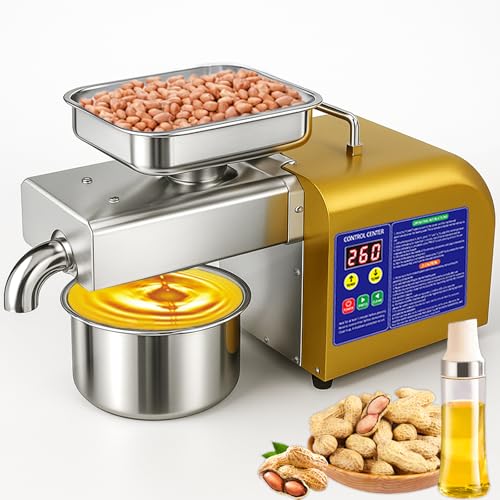
- Rated for 11 to 20 pounds per hour
- Supports hot and cold extraction
- Displays and adjusts temperature in real time
Best For: Frequent pressing where speed matters more than compactness
Best Easy-Operation Pick

- Uses simple preheat-and-start controls
- Processes dry or moist seeds without roasting
- Low-temperature operation with 304 stainless steel parts
Best For: Beginners making modest batches in a home kitchen
Best All-Rounder
610W Stainless Steel Oil Press

- Cold and hot pressing modes
- 104°F–410°F temperature control
- 8.8 lb/h stated capacity
Best For: Home cooks seeking flexible pressing and temperature control
Best for Heated Pressing

- Digital temperature display
- 8-minute preheat countdown
- Auto shutoff and cooling features
Best For: Users wanting simpler, monitored hot pressing
Best for Capacity
- 8.8 lb/h stated processing capacity
- Cold and hot pressing modes
- Residue separation with included filter
Best For: Frequent users processing larger home batches
High-Capacity Electric Pick – 820W Hot and Cold Oil Press
For shoppers comparing oil presses for small kitchens, this 820W stainless steel model offers automatic hot- and cold-press settings with temperature monitoring. Its larger capacity and continuous operation are useful when you want to process substantial batches of seeds or nuts, although its listed footprint is better suited to kitchens with dedicated counter space.
Best For: Home users who want automatic operation, adjustable temperature control, and high-volume seed and nut pressing.
Pros:
- Supports both hot and cold pressing, with a 104–464°F temperature range.
- Handles peanuts, walnuts, sunflower seeds, sesame, soybeans, flaxseed, and several other listed materials.
- 820W motor, stainless-steel construction, included filter, cup, gloves, and cleaning brush.
Cons:
- Its 14.9-inch width and 13.5-pound capacity may be substantial for a very small kitchen.
- Not recommended for olives, cocoa beans, spices, flowers, herbs, or coffee beans.
- Hand-wash care may add cleanup time.
This is the most automation- and capacity-focused option in the group. It makes sense when output and temperature control matter more than the smallest possible footprint.
Compact Manual Choice – Gralara Small Kitchen Oil Press
This Gralara manual press is a straightforward choice among oil presses for small kitchens, using a hand crank rather than electricity. The stainless-steel construction is designed for repeated home use, and the simple setup can appeal to shoppers who prefer direct control over a powered appliance.
Best For: Users seeking a manually operated press for occasional home batches of peanut, rapeseed, walnut, tea, or sunflower oil.
Pros:
- Requires no electricity, so it can be used whenever needed.
- Stainless-steel body is designed to be sturdy and easy to wipe clean.
- Includes a collection bottle and supports manual cold- or hot-pressing needs.
Cons:
- Hand-crank operation requires more physical effort than an electric model.
- The listed dimensions are unusually large for a product described as small, so verify available space.
- Hand-wash care is required.
The Gralara focuses on simplicity rather than speed or automation. Check the dimensions carefully, but consider it if quiet, electricity-free operation is your priority.
Versatile Electric Pick – Garvee 900W Hot and Cold Press
The Garvee 900W press gives small-kitchen shoppers a versatile electric option with cold, hot, and frying settings. Its 304 food-grade stainless-steel construction and included cleanup accessories support regular use, while the listed 21.46-inch depth means counter space should be measured before buying.
Best For: Home cooks who want multiple pressing modes for nuts and seeds, including peanuts, sesame, flaxseed, walnuts, almonds, pumpkin seeds, and rapeseed.
Pros:
- Offers hot, cold, and frying settings with a built-in thermostat heating device.
- Uses 304 food-grade stainless steel for the main construction.
- Includes insulation gloves, cleaning brush, oil barrel, and colander.
Cons:
- The deep 21.46-inch listed dimension may be challenging on a shallow counter.
- The notes describe it as portable, but its footprint is larger than some compact manual presses.
- Olive preparation requires removing the pit flesh and drying it first.
This model stands out for setting flexibility and included accessories. It is a strong fit when you want an electric press that can handle varied seed and nut ingredients, provided you have enough counter depth.
Hands-On Stainless Pick – CGOLDENWALL Manual Oil Press
For oil presses for small kitchens, the CGOLDENWALL manual extractor offers a relatively narrow 4-inch listed width and a hands-on way to press oil without relying on an electric motor. Its stainless-steel body and handle are designed for durability, while the manual process suits users who prefer simple physical pressing.
Best For: Hands-on users pressing higher-oil-content crops such as peanuts, sunflower seeds, tea seed, sesame, walnut, or coconut.
Pros:
- Manual operation uses physical pressing without chemical ingredients.
- 304 stainless-steel body and handle are designed to resist rust.
- Portable design, 1-liter capacity, English instructions, and a one-year warranty.
Cons:
- Manual operation is slower and more labor-intensive than an automatic press.
- The notes do not recommend flaxseed, rapeseed, or olives.
- Continuous heating during use requires care and attention.
This is a practical narrow-format option for users who value a durable manual setup. Its ingredient limitations and heating requirement make it better for focused, attentive use than broad, automated processing.
Best Balanced Capacity – VEVOR 8.27-Lb/H Oil Press
For shoppers comparing oil presses for small kitchens, the VEVOR offers a practical balance of output, ingredient flexibility, and manageable countertop dimensions. Its 250-watt electric system can hot-press up to 8.27 pounds of flaxseed per hour, while adjustable temperature settings support different seeds and nuts.
Best For: Home cooks who want versatile hot pressing with useful accessories and moderate hourly capacity.
Pros:
- Presses up to 8.27 pounds per hour and supports more than 30 types of nuts and seeds.
- Adjustable hot-pressing temperature from 122°F to 572°F.
- Includes an oil cup, filter screen, gloves, and cleaning brush.
- Stainless steel core components are designed for high-temperature, high-pressure use.
Cons:
- At 23.8 pounds, it is substantial for a small kitchen appliance.
- The supplied specifications describe hot pressing rather than cold pressing.
Its 20.47-by-6.3-by-11.42-inch footprint is relatively narrow but tall, so measure the intended counter or storage area. This is a capable choice when ingredient versatility matters more than the lightest setup.
Best High-Output Option – 1800W Automatic Seed Oil Press
This 1800-watt model is aimed at buyers who want high throughput from oil presses for small kitchens but also need commercial-style capacity. It offers hot and cold extraction, a temperature range of 104°F to 572°F, and a stated output of 11 to 20 pounds per hour.
Best For: Frequent home users or small-scale operators who prioritize speed and extended operating capability.
Pros:
- High-powered 1800-watt system with stated output of 11 to 20 pounds per hour.
- Supports hot and cold extraction with real-time temperature display and adjustment.
- Made with a stainless steel pressure rod and all-steel gears.
- Includes a hopper, oil cup, filter, cleaning brush, gloves, and other pressing parts.
Cons:
- Its 25.1-pound weight and 21.8-by-11.6-by-11.1-inch package dimensions may challenge tight kitchens.
- Freshly pressed oil should settle for 24 hours before separation and use.
- It cannot press cocoa beans, spices, flowers, herbs, or coffee beans.
The intelligent panel and countdown simplify operation, but this is a larger, more power-hungry choice than many household presses. Confirm you have sufficient counter space and realistic ingredients for its stated capabilities.
Best Easy-Operation Pick – Household Foolproof Oil Press
For beginners choosing among oil presses for small kitchens, this household model emphasizes straightforward controls and low-temperature extraction. Preheat it, add the oilseeds, and press start; its constant-temperature heater and cooling fan are designed to support even heating and continuous squeezing.
Best For: First-time users who want simple kitchen operation, low-temperature pressing, and no required pre-roasting.
Pros:
- Simple preheat-and-start operation suited to beginners.
- Accepts dry or moist oilseeds without pre-roasting.
- Uses food-grade 304 stainless steel for the pressing chamber and screw rod.
- Supports multiple seeds and has a stated processing speed of 6 pounds per hour.
Cons:
- At 22 pounds, it is not especially light for frequent storage.
- Its single-speed design offers less adjustment than a multi-setting press.
- Olive pits must be removed before pressing.
The 17.3-by-6.3-by-11-inch dimensions give it a narrow footprint, although users should still plan for its height and weight. Its low-temperature focus and uncomplicated controls make it a sensible everyday option for modest batches.
Best All-Rounder – 610W Stainless Steel Oil Press
For shoppers comparing oil presses for small kitchens, this 610W model combines cold and hot pressing with temperature control in a stainless-steel body. Its stated 8.8-pound-per-hour capacity is substantial, so it suits households that want flexibility for nuts and seeds as well as occasional larger batches.
Best For: Home cooks who want dual pressing modes, adjustable heat, and included filtering accessories.
Pros:
- Supports both cold and hot pressing for different ingredients.
- Precise temperature control from 104°F to 410°F with a display.
- SUS304 stainless-steel construction and included filter, bowl, brush, gloves, and manual.
- Rated for up to 8.8 pounds per hour with a stated 2% residual oil rate.
Cons:
- Hand-wash care may add cleanup time.
- The relatively high processing capacity may be more than some small households need.
Its combination of temperature management, residue separation, and broad ingredient compatibility makes it a versatile choice. Before buying, confirm that your counter has room for a commercial-style appliance and that the batch capacity matches your routine.
Best for Heated Pressing – Automatic 610W Oil Press
This automatic 610W press is a practical option among oil presses for small kitchens when timed heating and safety features matter. It supports hot and cold pressing, includes a digital temperature panel, and uses an 8-minute preheat countdown to simplify preparation.
Best For: Users who prioritize automatic preheating, digital temperature monitoring, and overheating protection.
Pros:
- Offers hot and cold pressing for peanuts, sesame, coconut, soybeans, sunflower seeds, and walnuts.
- Digital panel shows the set and real-time temperature.
- 8-minute preheat countdown reduces manual timing.
- Includes overheating protection with auto power-off, cooling holes, and a built-in fan.
Cons:
- The product information lists a 610W maximum power while the model name says 650W, so specifications should be verified.
- Hand-wash care may require extra maintenance.
- Its listed 13.2-pound capacity may be excessive for occasional small batches.
This model stands out for convenience during heated pressing, particularly if you appreciate a countdown and automatic protection. Verify the wattage and available counter space before choosing it for a compact kitchen.
Best for Capacity – 610W Intelligent Oil Press
For a small kitchen that occasionally handles larger ingredient runs, this intelligent 610W oil press offers an advertised 8.8-pound-per-hour throughput in a compact-width design. Cold and hot modes, residue separation, and straightforward controls cover the main features to compare when selecting oil presses for small kitchens.
Best For: Frequent home users who want higher throughput, adjustable temperatures, and filtered oil output.
Pros:
- Processes up to 8.8 pounds per hour at a stated 80 RPM.
- Supports cold and hot pressing with a 104°F–410°F temperature range.
- Oil-residue separation and an additional filter help remove solid particles.
- Includes a bowl, filter, cleaning brush, gloves, power cord, and English manual.
Cons:
- At 16.93 inches deep, it may need more counter depth than some small kitchens provide.
- Hand-wash care can make cleanup less convenient.
- Its high stated capacity may be unnecessary for users pressing only small quantities.
The clearly listed dimensions are useful for planning counter placement, while the throughput and residue separation favor repeat use. Measure your workspace carefully and consider whether your typical batches justify its larger capacity.
How We Picked the Best Oil Presses for Small Kitchens
We focused on the practical requirements of home oil pressing: footprint, operating power, extraction options, controls, materials, capacity, and cleanup. The selection includes manual presses for occasional use and electric models ranging from compact household machines to faster, higher-capacity units. Because product specifications can vary by seller and configuration, confirm voltage, included accessories, hopper size, and warranty details before ordering.
For a small kitchen, convenience matters as much as extraction performance. A powerful machine may finish batches faster, but it can occupy more counter space and produce more heat, noise, and cleanup. Manual models generally need more physical effort but are easier to store and can be useful when pressing only small quantities.
Quick Comparison
| Type | Best for | Main advantage | Potential trade-off |
|---|---|---|---|
| Manual | Occasional small batches | Compact and simple | Requires hand effort |
| Compact electric | Regular home use | Convenient automated pressing | Needs counter and storage space |
| High-power electric | Larger or frequent batches | Faster processing | More heat, noise, and energy use |
| Commercial-style | Heavy-duty home or shared kitchens | Higher throughput and controls | Usually larger and costlier |
Key Buying Factors for Oil Presses for Small Kitchens
Size, Storage, and Capacity
Measure the counter and cabinet space before buying. Check both the machine footprint and the height needed to add seeds or remove containers. A larger hopper or higher output can reduce refill time, but may be unnecessary for occasional pressing.
Hot and Cold Pressing
Hot pressing can improve flow and yield for some seeds, while cold pressing is preferred by buyers who want lower-temperature processing. Adjustable temperature controls are useful, but verify the actual temperature range and how clearly it can be set.
Power, Speed, and Noise
Higher wattage can support demanding batches, but it does not alone determine oil yield. Look for motor protection, continuous-use guidance, speed controls, and customer feedback about noise or overheating. A lower-powered machine may be the better fit for a compact kitchen used in short sessions.
Materials and Cleaning
Food-contact stainless steel is generally practical and durable. Removable pressing parts, accessible residue channels, and included cleaning tools can make a larger difference than extra features. Confirm which components can be washed safely and whether the machine must cool completely before cleaning.
Compatibility and Safety
Check that the press supports the seeds and nuts you plan to use. Some foods require preparation, such as drying, shelling, chopping, or preheating. Also verify the electrical voltage, grounding requirements, automatic shutoff features, and the manufacturer’s recommended duty cycle.
Who Should Buy Which Oil Presses for Small Kitchens?
Choose a manual model if you press small amounts infrequently, have very limited storage, or want the simplest setup. Choose a compact automatic press if convenience and repeatable results matter more than minimizing equipment. A higher-powered 820W or 900W machine may suit households that process seeds regularly, while 1800W and commercial-style models are better for larger batches or demanding schedules—provided you have adequate ventilation and counter space.
Before deciding among these Oil Presses for Small Kitchens, prioritize the ingredients you use most, expected batch size, cleaning tolerance, and available electrical capacity. The best choice is not necessarily the fastest machine; it is the one you can store, operate, and clean consistently.